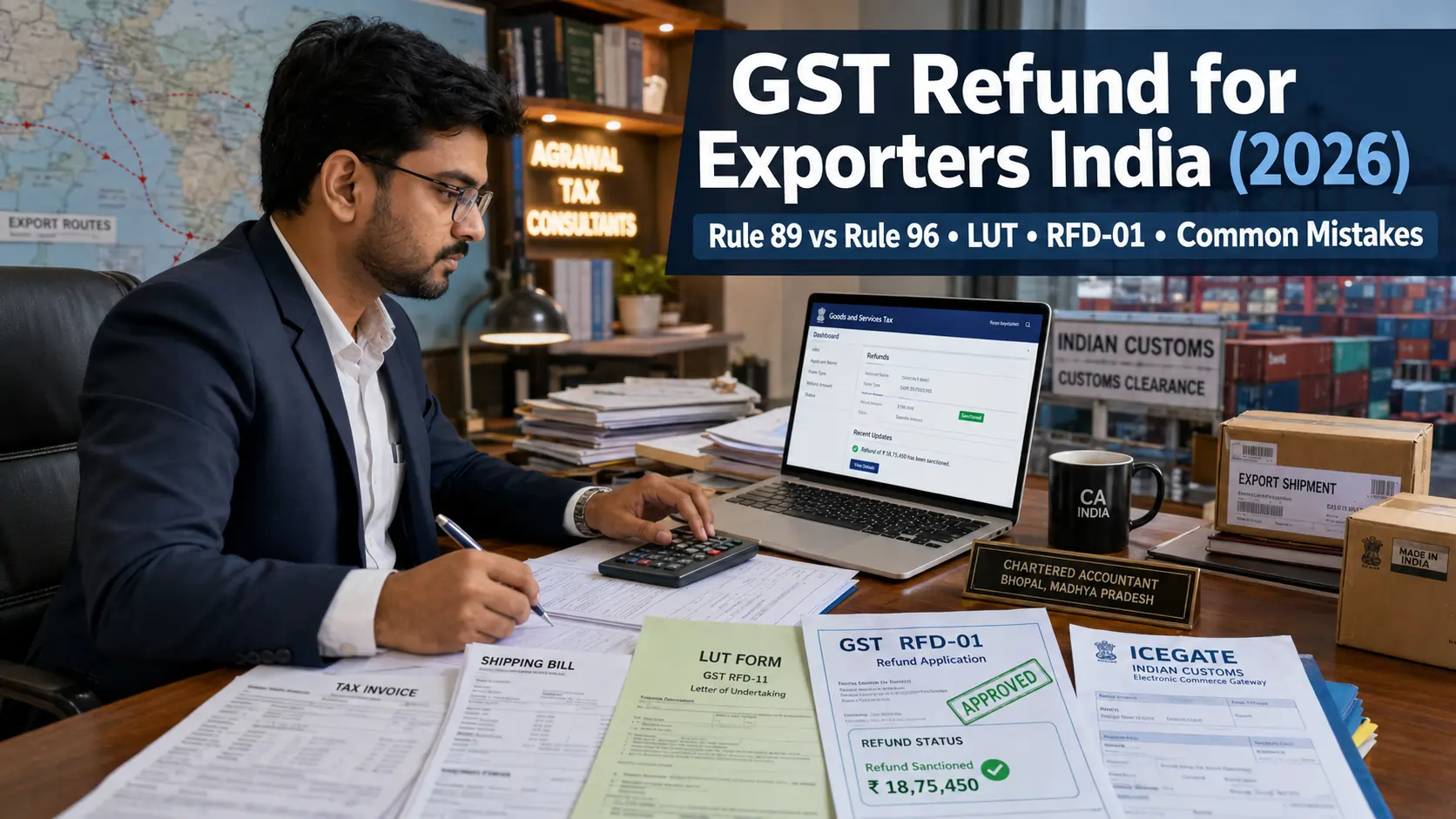
GST Refund for Exporters India: Complete Process, Rules & Common Mistakes (2026)
If you're an exporter based in India, you've probably heard the term GST refund for exporters India more times than you can count. And yet, for many businesses, the actual process of claiming this refund remains confusing, delayed, or worse - rejected.
Here's the truth: India's GST framework treats exports as zero-rated supplies under Section 16 of the IGST Act. That means you're legally entitled to a full refund of the taxes you've paid - either on the goods/services exported or on the inputs used to produce them. But claiming that refund requires following a precise process, filing the right forms, and avoiding a handful of very common mistakes.
In this guide, we'll walk through everything - the two refund routes, the documents you need, the April 2026 rule updates, and the mistakes that get claims rejected. Whether you're a first-time exporter or you've been doing this for years, this guide will save you time, money, and frustration.
| Quick Fact: Under the GST framework, exports are zero-rated under Section 16 of the IGST Act, 2017.This means exporters can claim a full refund of GST paid - either on inputs or on IGST paid at the time of export.The two main routes are Rule 89 (LUT/Bond route) and Rule 96 (IGST payment route) of the CGST Rules. |
What is GST Refund for Exporters? Understanding Zero-Rated Supply
Before diving into the process, it's important to understand why exporters are entitled to a refund in the first place.
Under Section 16 of the IGST Act, 2017, exports of goods and services are classified as zero-rated supplies. This is fundamentally different from an exemption. A zero-rated supply means that while the output tax rate is 0%, the exporter can still claim Input Tax Credit (ITC) on inputs used in making those exports.
In simple terms: you pay GST on raw materials, freight, packing, etc. When you export the finished product, you pay 0% GST on the sale. The government then owes you a refund of the GST you paid on inputs.
This applies to:
- Exports of goods - physical products shipped outside India
- Exports of services - where payment is received in foreign currency
- Supplies to Special Economic Zones (SEZ) - both goods and services
The legal authority for claiming this GST refund for exporters India lies under Section 54 of the CGST Act, read with Rule 89 and Rule 96 of the CGST Rules, 2017.
Also Read: GST Changes from April 2026: What Every Business Must Know Before the Deadline
Two Routes to Claim GST Refund: GST Export Refund Rule 89 vs Rule 96
This is where many exporters get confused. There are two distinct routes to claim a GST refund for exporters India, and choosing the wrong one - or mixing them up - can lead to rejection or delays.
| Feature | Rule 96 – IGST Payment Route | Rule 89 – LUT/Bond Route |
| GST Paid at Export? | Yes – IGST paid on export | No – Export without payment of tax |
| Form Required | Shipping Bill acts as refund application | Form RFD-01 on GST portal |
| Processing System | ICEGATE (automated) | GST portal (manual) |
| LUT Required? | No | Yes – mandatory |
| Ideal For | Exporters with high IGST liability | Exporters who want to avoid cash blockage |
Route 1 – IGST Payment Route (Rule 96): Shipping Bill as Refund Application
Under Rule 96 of the CGST Rules, if you pay IGST at the time of export, the shipping bill itself acts as your refund application. This is a largely automated process handled through ICEGATE (the Customs' electronic gateway) and the GST portal.
Here's how it works step by step:
- File GSTR-1 with export details in Table 6A (export of goods) or Table 6B (export of services).
- File GSTR-3B, ensuring IGST liability is declared and paid.
- The system matches your shipping bill with GSTR-1 Table 6A data via ICEGATE.
- Once the Export General Manifest (EGM) is filed by the shipping line/airline, the refund is processed automatically.
- Refund is credited to your registered bank account.
| Pro Tip: The biggest reason refunds fail under Rule 96 is a mismatch between the shipping bill details filed with Customs and the data in GSTR-1 Table 6A. Always reconcile before filing. |
Route 2 – LUT/Bond Route (Rule 89): Export Without Payment of Tax + Form RFD-01
Under Rule 89 of the CGST Rules, you export without paying IGST - by furnishing a Letter of Undertaking (LUT) or bond. You then claim a refund of the ITC accumulated on your inputs through Form RFD-01 on the GST portal.
LUT Filing for Export GST - What You Need to Know
The LUT (Letter of Undertaking) is a declaration filed on the GST portal that you will comply with all export obligations without paying IGST. It must be filed before the export takes place.
- Who can file LUT? Any registered taxpayer who has not been prosecuted for tax evasion exceeding ₹2.5 crore.
- How to file? Login to GST portal → Services → User Services → Furnish Letter of Undertaking (LUT)
- Validity: One financial year. Must be renewed every year before April 1.
- Form RFD-01 is then filed for claiming ITC refund. You must select the correct category: 'Refund of ITC on account of Export of Goods/Services without payment of tax.'
Most CA professionals recommend the LUT route for exporters with large input tax credits, as it avoids cash flow blockage of IGST payments.
GST Refund Documents Required for Export: Complete Checklist
Whether you're applying under Rule 89 or Rule 96, having the right GST refund documents required for export is non-negotiable. Missing even one document can result in a deficiency memo and restart the clock on your refund.
| Document | Purpose | Applicable Route |
| Shipping Bill | Proof of export / Refund application under Rule 96 | Both |
| Export General Manifest (EGM) | Confirms goods have left India | Rule 96 |
| Bank Realisation Certificate (BRC) / FIRC | Proof of foreign exchange receipt (for services) | Rule 89 (Services) |
| Form RFD-01 | GST portal refund application | Rule 89 |
| LUT Acknowledgement | Proof of LUT filing | Rule 89 |
| GSTR-1 and GSTR-3B copies | Reconciliation / evidence of declared exports | Both |
| Tax Invoices | Proof of ITC claimed on inputs | Rule 89 |
| Statement of Invoices (Annexure-B) | Filed along with RFD-01 | Rule 89 |
| CA Certificate (if applicable) | Required for amounts above ₹2 lakh | Rule 89 |
Important Note: For service exporters, the Bank Realisation Certificate (BRC) or Foreign Inward Remittance Certificate (FIRC) is critical. Without it, your refund will be held up regardless of everything else being in order.
Also Read : GST Compliance Guide for Businesses and Startups in India (2026) – Complete Step-by-Step
Common Mistakes That Get GST Refund Rejected - And How to Avoid Them
This is the section most exporters wish they'd read before filing. The GST refund rejected reason for exporters almost always comes down to one of these avoidable errors:
1. GSTR-1 vs GSTR-3B Mismatch - The #1 Refund Killer
A GSTR-1 GSTR-3B mismatch is the most common reason for GST refund rejection or delay. Here's why it happens and how to fix it:
- What is it? The IGST declared in GSTR-1 Table 6A (exports) doesn't match the IGST paid in GSTR-3B.
- Why it matters: The ICEGATE system automatically compares both returns. A mismatch flags your refund for manual review - or outright rejection.
- How to avoid it: Reconcile GSTR-1 and GSTR-3B before filing every month. Use the GSTR-2B matching tool on the portal.
If you've already filed with a mismatch, file a GSTR-1A amendment or a GSTR-3B amendment (where permitted) to correct the discrepancy before the refund is processed.
2. Shipping Bill Details Don't Match GSTR-1
The invoice number, date, GSTIN, and taxable value in your shipping bill must exactly match what's entered in GSTR-1 Table 6A. Even a small typographical error in the invoice number can break the automated match on ICEGATE.
3. EGM Not Filed or Delayed
The Export General Manifest (EGM) is filed by the carrier (shipping line, airline, etc.) with Customs. If EGM is delayed or not filed, the refund gets stuck at the ICEGATE end even if your GSTR-1 data is perfect. Always track EGM status through the Customs ICEGATE portal.
4. LUT Not Renewed Before Export
If you're on the LUT route and your LUT expires (it's valid for one financial year), any exports made after expiry without a renewed LUT will be treated as exports with IGST liability - causing compliance issues and delayed refunds. Renew your LUT every year before April 1.
5. Wrong Refund Category Selected in RFD-01
Form RFD-01 has multiple refund categories. Selecting the wrong one - for example, choosing 'excess balance in cash ledger' instead of 'ITC on account of zero-rated supplies' - will result in a deficiency memo and force you to refile.
6. BRC/FIRC Not Submitted for Service Exports
For GST refund for service exporters India, the Bank Realisation Certificate (BRC) or Foreign Inward Remittance Certificate (FIRC) is mandatory evidence that foreign exchange was received. Without it, your claim will be held up. Make sure your bank issues this promptly after payment is received.
7. Ignoring Inverted Duty Structure Claims
If you're an exporter who also sells domestically and your input tax rate is higher than the output tax rate, you may be eligible for an inverted duty structure GST refund. Many exporters miss this. File a separate RFD-01 claim under the 'Inverted Tax Structure' category to recover this credit.
GST Refund Process for Exporters 2026: April Updates You Must Know
The CBIC and GST Council have introduced several significant updates effective from April 2026 under what's being referred to informally as GST 2.0 export rules. Here's what changed and how it affects your GST refund for exporters India:
90% Provisional GST Refund Within 7 Days - 2026 Update
Under the previous framework, provisional refunds were processed within 7 days but at 90% of the claimed amount. The April 2026 amendment has made this process faster and more transparent.
Key updates to the provisional GST refund 90 percent rule:
The 90% provisional refund must now be credited within 7 working days of the acknowledgement of RFD-01.
- The remaining 10% is released after final verification, which must be completed within 60 days.
- If the department fails to process within 60 days, interest at 6% per annum is payable from the 61st day.
- Exporters on the Green Track (trusted exporters with clean compliance history) may receive faster processing under the automated CBIC refund circular framework.
GST Refund Minimum Threshold Removed - 2026 Update
One of the most welcomed changes: the earlier ₹1,000 minimum threshold for filing a GST refund for exporters India has been removed effective April 2026. This benefits smaller exporters and MSME exporters who previously couldn't claim small refund amounts.
Service Exporters - Relaxed BRC/FIRC Norms
For GST refund for service exporters India, the 2026 update introduces relaxed documentary requirements:
- SWIFT messages and payment acknowledgements from authorized banks are now accepted as interim proof while BRC/FIRC is awaited.
- The time limit for submitting BRC/FIRC has been extended to 12 months from the date of export in most cases.
- SEZ units and developers can now apply digitally with minimal manual documentation.
Integration with RoDTEP Scheme
From April 2026, the GST portal is more tightly integrated with the RoDTEP (Remission of Duties and Taxes on Exported Products) scheme. Exporters claiming both GST refund and RoDTEP benefits must ensure their IEC code, GSTIN, and shipping bill data are consistent across all platforms.
Also Read : Export of Goods and Services under GST in India – Complete Guide for 2026
GST Refund Timeline: What to Do If Your Refund is Delayed Beyond 60 Days
Knowing the GST refund time limit for exporters is essential. Here's the official timeline:
| Stage | Timeline | Action Required |
| Acknowledgement of RFD-01 | Within 2 working days | Verify acknowledgement on portal |
| Provisional Refund (90%) | Within 7 working days | Track under GST portal refund status |
| Final Refund Order | Within 60 days of application | Follow up if exceeded |
| Interest on Delayed Refund | From 61st day onwards | Claim 6% p.a. interest |
| Maximum Overall Limit | 2 years from relevant date | Do not delay filing |
GST refund delayed 60 days - what to do:
- Track your refund status on the GST portal under Services → Track Application Status.
- Check for any deficiency memo or notice for rejection that may have been issued. Respond within the stipulated time.
- File a grievance on the CBIC GST portal if there is no response.
- You can also approach the jurisdictional GST Commissioner with a written representation citing Section 54(7) of the CGST Act.
- If all else fails, file a writ petition before the High Court - courts have consistently granted relief where refunds are delayed without valid reason.
Remember: under Section 56 of the CGST Act, you are entitled to interest at 6% per annum on delayed refunds from the 61st day. Don't leave this money on the table.
Frequently Asked Questions: GST Refund for Exporters
Q1. What is the GST refund time limit for exporters?
The time limit for filing a GST refund for exporters India is 2 years from the relevant date. For exports, the 'relevant date' is the date of export (date of bill of lading for goods). The department must process and grant the refund within 60 days of your application.
Q2. What is Form RFD-01 and when do I file it?
Form RFD-01 is the GST refund application form filed on the GST portal. You file it when claiming a refund under the LUT/Bond route (Rule 89). It's not required under Rule 96 (IGST payment route) since the shipping bill serves as the refund application there.
Q3. My GST refund is delayed beyond 60 days. What should I do?
First, check for any pending deficiency memo or rejection notice on the GST portal. If there's none and it's simply delayed, file a grievance on the CBIC portal and send a written request to the jurisdictional Commissioner. You are also entitled to 6% interest p.a. from the 61st day under Section 56 of the CGST Act.
Q4. Can service exporters claim GST refund?
Yes. GST refund for service exporters India is available when services are exported as per Section 2(6) of the IGST Act - i.e., the service is supplied to an overseas recipient and payment is received in convertible foreign exchange. Service exporters must submit BRC/FIRC as proof, or SWIFT messages under the relaxed 2026 norms.
Q5. What is the inverted duty structure GST refund?
An inverted duty structure GST refund applies when the GST rate on inputs is higher than the GST rate on the output/export. In such cases, ITC accumulates and cannot be adjusted - so you can claim a refund of the accumulated ITC under Section 54(3) of the CGST Act via Form RFD-01.
Q6. What changed in April 2026 regarding the GST refund minimum threshold?
The GST refund exporter minimum threshold has been removed in 2026. Previously, refund claims below ₹1,000 could not be filed. This barrier has been lifted, benefiting small and MSME exporters who can now claim even smaller amounts.
Q7. How do I track my GST refund status?
Login to the GST portal → Services → Track Application Status → Enter your ARN (Application Reference Number). You can see whether your application is Pending, Under Processing, Deficiency Raised, Approved, or Rejected.
Need Help with GST Refund? Work with a CA in Bhopal
| GST Refund CA Bhopal | Export GST Consultant Bhopal Navigating GST refund claims - especially as an exporter - is far more complex than it looks. Filing errors, mismatches, and missed deadlines can cost you lakhs in delayed or rejected refunds. CA Yash Garg | cayashgarg.com | Bhopal, Madhya Pradesh Services offered: • End-to-end GST refund filing for exporters (Rule 89 & Rule 96) • LUT filing and renewal • GSTR-1 / GSTR-3B reconciliation and mismatch resolution • RFD-01 preparation and submission • Refund follow-up and grievance filing • GST advisory for service exporters and MSME exporters Contact: Visit cayashgarg.com or call to schedule a free initial consultation. Serving exporters across Bhopal, Madhya Pradesh, and pan-India remotely. |
Conclusion: Don't Leave Your GST Refund on the Table
If you're exporting from India, the GST refund for exporters India is not a bonus - it's your legal right. The framework under Section 16 of the IGST Act and Section 54 of the CGST Act exists precisely to ensure that Indian exports remain competitive by relieving the tax burden on exported goods and services.
The key is to choose the right route (Rule 89 or Rule 96), file the correct forms (RFD-01 or shipping bill), maintain your documents, and reconcile your GSTR-1 and GSTR-3B every single month.
With the April 2026 updates removing the minimum threshold, improving provisional refund timelines, and relaxing norms for service exporters, it's a better time than ever to get your refund claims in order.
If you're unsure about any step, or if your refund has been delayed or rejected, don't try to handle it alone. Work with a qualified export GST consultant in Bhopal or your nearest CA who specializes in GST refunds.
Your working capital deserves better than sitting in a government ledger. Claim what's yours.