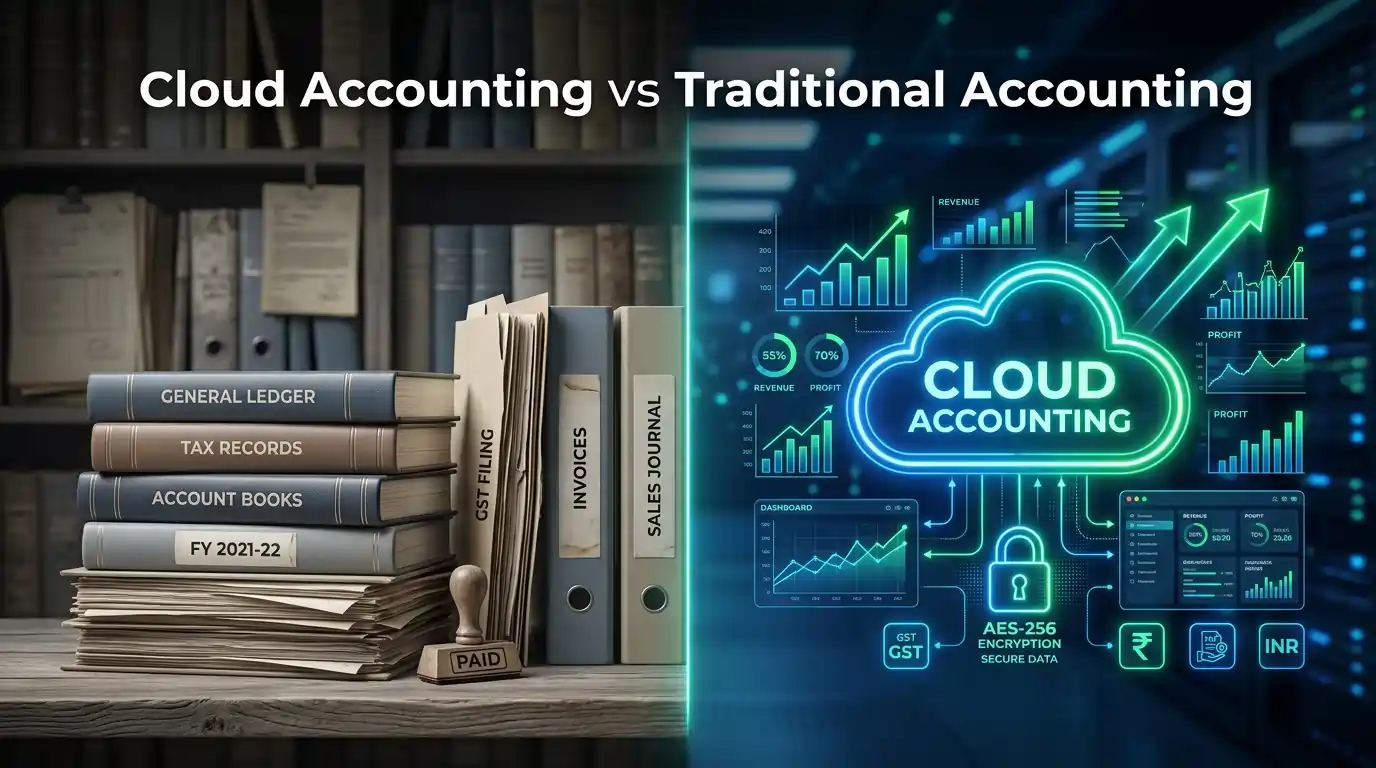
Cloud Accounting vs Traditional Accounting: Which is Better for Your Indian Business in 2026?.
The Accounting Revolution Happening Right Now in India
If you run a small or medium business in India today, you have probably faced this question at least once - should I stick with my Tally setup or move everything to a cloud-based system? It sounds like a technical decision, but it is actually one of the most important financial decisions you can make for your business growth. Cloud accounting vs traditional accounting is no longer just a topic for large corporates or IT-savvy startups. With GST e-invoicing now mandatory for businesses with ₹5 crore+ turnover, rising compliance complexity, and the reality of remote teams, the way you manage your books directly impacts how well your business survives and scales.
In this blog, CA Yash Garg - a practicing Chartered Accountant based in Bhopal with over 10 years of experience - breaks down the key differences between cloud accounting vs traditional accounting, explains what works for which type of business, and helps you make an informed decision for 2026 and beyond. Whether you are a startup founder, an MSME owner, a freelancer, or a corporate finance head, this guide is written specifically for the Indian business context.
Did You Know? According to industry reports, AI-driven cloud accounting automation is expected to reduce manual accounting workload by 60-80% for Indian businesses by 2026. Yet thousands of MSMEs across Madhya Pradesh still rely on traditional, desktop-based bookkeeping - unknowingly putting themselves at a competitive disadvantage
Also Read - GST Changes from April 2026: What Every Business Must Know Before the Deadline
What is Cloud Accounting? A Simple Definition for Indian Business Owners
Cloud accounting refers to accounting software and financial management systems that are hosted on secure internet servers - not installed on your local computer or office desktop. This means you can access your ledgers, invoices, GST filings, financial reports, and real-time data from anywhere in the world using a browser or mobile app.
Popular cloud accounting platforms used by Indian businesses include:
- Zoho Books - built by an Indian SaaS company with full GST integration
- QuickBooks Online - globally popular with strong reporting features
- Xero - preferred by businesses with international clients
- Marg ERP - widely used in pharma and distribution industries
- TallyPrime on Cloud - for businesses wanting Tally familiarity with remote access
Unlike traditional software, cloud platforms update automatically, sync with bank feeds, and allow your CA, accountant, and business partner to work simultaneously on the same data - no emailing Excel files back and forth.
Cloud accounting is an internet-based financial management system where data is stored and processed on remote servers, allowing real-time access, collaboration, and automated compliance - unlike traditional desktop-based accounting software installed locally on a single computer.
What is Traditional Accounting? Understanding the Old-School Model
Traditional accounting - also called on-premise or desktop accounting - is the older method where accounting software is installed on your office computer or server. TallyPrime (formerly Tally ERP 9) is India's most widely used traditional accounting tool, with an estimated 70% market share among computerised Indian businesses.
In this model:
- Software is installed locally on one or more office computers
- Data is stored on your hard drive or internal server
- Access is limited to the physical location of the machine
- Updates are manual and often paid separately
- Multiple users need to be physically present or connected via a local network
Traditional accounting tools like Tally are powerful, deeply embedded in Indian CA workflows, and extremely reliable for GST compliance, inventory management, and statutory filings. However, they carry limitations that become increasingly painful as your business grows, adds remote employees, or requires your CA to access books from outside your office.
Also Read - MSME Registration in India 2026: Benefits, Process & Documents Required
Cloud Accounting vs Traditional Accounting: Head-to-Head Comparison
The table below gives you a clear, India-specific comparison of both approaches across the most critical parameters:
| Parameter | Cloud Accounting | Traditional Accounting |
| Access | Anywhere, any device, 24/7 | Office location only |
| GST Compliance | Auto-updated with GSTN changes | Manual updates required |
| E-Invoicing | Built-in, auto-generated | Requires third-party add-ons |
| Data Backup | Automatic cloud backup | Manual backup - risk of data loss |
| Multi-User Access | Yes - CA, owner, team simultaneously | Limited - one user at a time mostly |
| Cost Model | Monthly/annual subscription (₹200-₹8,000/month) | One-time license + maintenance |
| Software Updates | Automatic and free | Manual and often chargeable |
| Internet Dependency | Required | Not required |
| Scalability | Highly scalable | Limited without upgrades |
| Data Security | Encrypted servers, MFA | Depends on local IT security |
| CA Collaboration | Real-time, remote | Physical access required |
| Bank Reconciliation | Automated via bank feeds | Manual entry |
| AI/Automation | Available - auto-categorisation, anomaly detection | Minimal |
| Best For | Startups, SMEs, MSMEs, growing businesses | Businesses with offline-only needs |
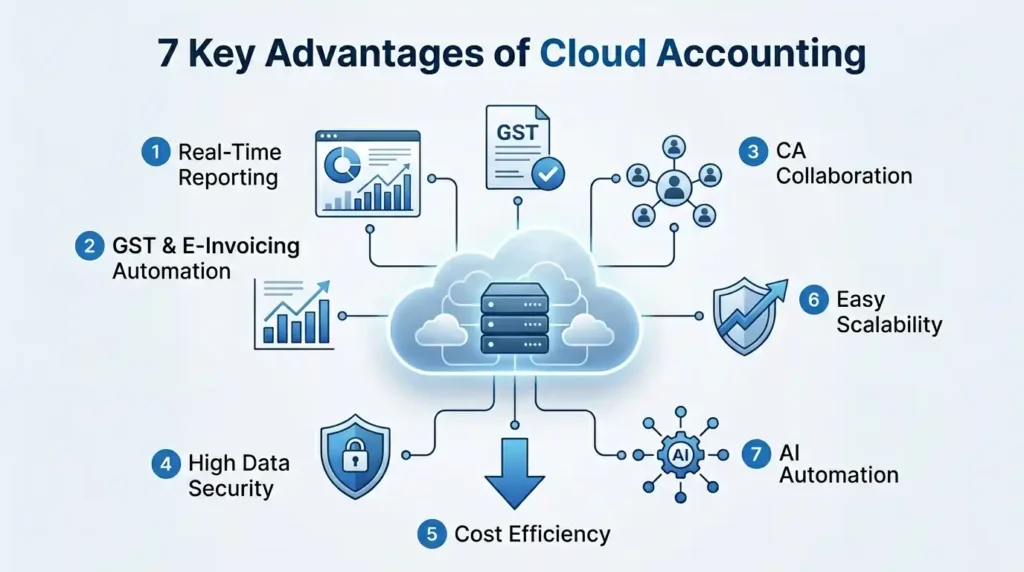
7 Key Advantages of Cloud Accounting Over Traditional Accounting in India
1. Real-Time Financial Reporting for Faster Decision-Making
One of the biggest advantages of cloud accounting is that your financial data is always live. Unlike traditional accounting where your P&L statement might be days or weeks old, cloud platforms give you a real-time dashboard showing revenue, expenses, receivables, and cash flow - updated the moment a transaction is recorded.
For Indian MSME owners who make daily decisions about purchases, credit, and pricing, real-time financial reporting is not a luxury - it is a competitive necessity. When your data is current, your decisions are sharper.
2. Automated GST Return Filing and E-Invoicing Compliance
India's GST system demands frequent and accurate filings - GSTR-1, GSTR-3B, GSTR-9, and now e-invoicing for applicable businesses. Cloud accounting software like Zoho Books and Marg ERP integrates directly with GSTN, automatically calculating tax liabilities, generating e-invoices, and filing returns with minimal manual effort.
With e-invoicing now mandatory in India for 2026 under the expanded threshold, businesses that rely on traditional manual methods face serious compliance risks - penalties, mismatches, and audit exposure. Cloud systems eliminate these risks by keeping your compliance automated and current.
Did You Know? As per the GST Council, businesses with turnover above ₹5 crore must generate e-invoices through the IRP (Invoice Registration Portal). Cloud accounting platforms do this automatically - traditional Tally users need costly third-party add-ons to achieve the same.
3. Seamless CA Collaboration - No More Emailing Tally Data Files
If you work with a CA (which every serious business should), traditional accounting creates unnecessary friction. Your CA needs your Tally data file, you export it, email it, they import it on their machine - and if something changes, the whole cycle repeats. Cloud accounting eliminates this entirely.
With platforms like Zoho Books or Xero, your CA gets a role-based login with exactly the level of access they need. They can review entries, prepare financials, and file returns without ever visiting your office. For CA Yash Garg's clients across Bhopal and Madhya Pradesh, this multi-user access and remote bookkeeping capability saves hours every month.
4. Data Security That Beats Your Office Setup
Many business owners worry: "Is cloud accounting safe for Indian businesses?" The answer, in most cases, is yes - more secure than your current setup.
Leading cloud accounting platforms provide:
- 256-bit AES encryption - same standard used by banks
- Multi-factor authentication (MFA) to prevent unauthorised access
- Automatic daily backups stored across multiple servers
- Role-based access control - your staff sees only what they need to
- SOC 2 compliance for platforms serving enterprise clients
Compare this to a traditional setup where your accounting data sits on a desktop that could be stolen, hit by a power surge, or lost in a fire - with no backup. Data security in cloud vs on-premise accounting clearly favours the cloud for most businesses.
5. Lower Long-Term Cost for Growing Businesses
The cost question is where most Indian business owners get confused. Traditional accounting software like Tally seems cheaper because it is a one-time license purchase (around ₹18,000-₹54,000). But the real cost of cloud accounting software for small business needs to account for:
- Tally annual maintenance charges (₹4,500-₹18,000/year)
- Hardware costs (dedicated desktop/server)
- IT support and manual backup systems
- Add-ons for e-invoicing, GST compliance, and remote access (Tally on Cloud hosting: ₹8,000-₹10,000/user/year)
When you add it all up, cloud accounting subscriptions starting at ₹200-₹9,000/year for Zoho Books or similar platforms are often more cost-effective - especially for businesses with 2-10 users.
6. Scalability Without Infrastructure Headache
Traditional accounting systems require you to buy more licenses, upgrade hardware, and manage IT as your business grows. Cloud accounting scales with a click - add users, increase storage, or unlock advanced features without touching a server. For Indian startups and SMEs growing from 5 to 50 employees, this flexibility is invaluable.
Also Read - Accounting and Bookkeeping Services in India: Complete Guide for Businesses
7. Accounting Automation and AI Integration
Modern cloud accounting platforms increasingly use AI and machine learning to:
- Auto-categorise transactions based on past patterns
- Flag anomalies and potential errors before they become problems
- Predict cash flow trends
- Match invoices with payments automatically
- Generate financial insights without manual analysis
Accounting automation for Indian startups and SMEs is accelerating rapidly. According to industry data, AI-powered accounting tools are projected to grow from USD 6.89 billion (2025) to USD 53.41 billion by 2034 globally - and India is one of the fastest-adopting markets.
Honest Disadvantages of Traditional Accounting - What No One Tells You
While traditional accounting tools like Tally remain powerful and widely used, the disadvantages of traditional accounting for growing businesses in India are becoming harder to ignore:
- Single-location access - you cannot check your books while travelling or working from home
- Manual GST updates - every GST rate change or new form requires a software update, often delayed or chargeable
- No real-time visibility - financial reports are always a few days behind
- Data loss risk - a single hard drive failure can destroy years of accounting records
- Collaboration friction - your CA, accountant, and you cannot work simultaneously
- Expensive scaling - adding users or branches requires additional licenses and infrastructure
- Limited bank integration - manual bank reconciliation is time-consuming and error-prone
- No mobile access - managing finances on the go is practically impossible
These are not small inconveniences - for a business trying to grow, compete, and stay compliant in 2026's regulatory environment, these are real operational bottlenecks.
Tally vs Zoho Books - The Most Relevant Comparison for Indian Business Owners
The Tally vs Zoho Books for Indian business debate is the most practical version of the cloud accounting vs traditional accounting discussion. Here is how they compare:
| Feature | TallyPrime | Zoho Books |
| Architecture | Desktop (cloud via third-party hosting) | Native cloud |
| GST Compliance | Excellent | Excellent |
| E-Invoicing | Via add-on | Built-in |
| Mobile Access | Limited | Full iOS + Android app |
| CA Integration | Manual data sharing | Real-time shared access |
| Bank Reconciliation | Manual | Automated bank feeds |
| Pricing | ₹18,000-₹54,000 license + hosting | ₹9,000-₹96,000/year |
| Learning Curve | Moderate (familiar to most CAs) | Easy |
| Ideal For | Manufacturing, inventory-heavy businesses | Startups, service businesses, MSMEs |
Tally remains excellent for manufacturing and inventory-heavy businesses with established CA teams. Zoho Books is the better choice for service businesses, startups, and anyone needing remote access and automation.
Did You Know? Many Indian businesses use a hybrid approach - keeping Tally for statutory compliance while using cloud tools for day-to-day visibility and reporting. Your CA can help you set up this system efficiently.
How to Migrate from Tally to Cloud Accounting in India - Step by Step
If you have decided to make the switch from manual accounting to cloud, here is a practical step-by-step migration guide:
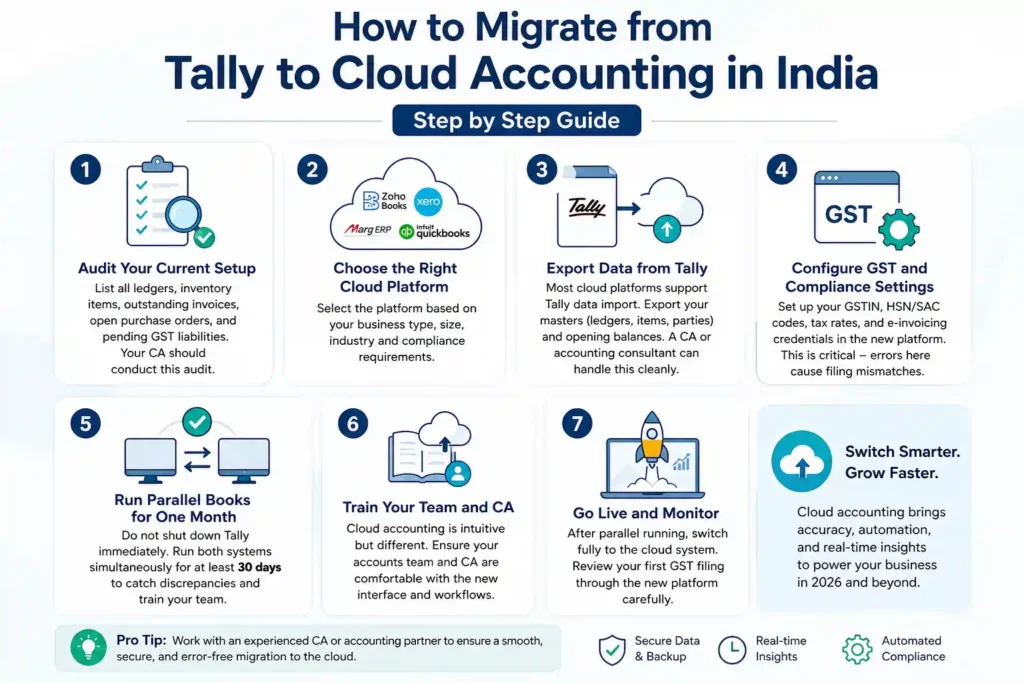
Step 1: Audit Your Current Setup Before migrating, list all your ledgers, inventory items, outstanding invoices, open purchase orders, and pending GST liabilities. Your CA should conduct this audit.
Step 2: Choose the Right Cloud Platform Based on your business type:
- Service/startup → Zoho Books or Xero
- Trading/inventory → Marg ERP or Zoho Books with inventory module
- Manufacturing → TallyPrime on Cloud or Marg ERP
- Multi-state/export → Xero or QuickBooks Online
Step 3: Export Data from Tally Most cloud platforms support Tally data import. Export your masters (ledgers, items, parties) and opening balances. A CA or accounting consultant can handle this cleanly.
Step 4: Configure GST and Compliance Settings Set up your GSTIN, HSN/SAC codes, tax rates, and e-invoicing credentials in the new platform. This is critical - errors here cause filing mismatches.
Step 5: Run Parallel Books for One Month Do not shut down Tally immediately. Run both systems simultaneously for at least 30 days to catch discrepancies and train your team.
Step 6: Train Your Team and CA Cloud accounting is intuitive but different. Ensure your accounts team and CA are comfortable with the new interface and workflows.
Step 7: Go Live and Monitor After parallel running, switch fully to the cloud system. Review your first GST filing through the new platform carefully.
CA Yash Garg's team provides end-to-end cloud accounting migration support for businesses in Bhopal and Madhya Pradesh - from platform selection to GST configuration and team training
Also Read - When Should a Business Outsource Accounting?
Which Type of Business Should Choose Cloud Accounting in India?
Cloud accounting is best suited for:
| Business Type | Recommendation |
| Startups and entrepreneurs | Strongly recommended |
| Freelancers and self-employed | Strongly recommended |
| Service-based SMEs | Strongly recommended |
| E-commerce and retail | Recommended |
| IT and software companies | Strongly recommended |
| Healthcare and clinics | Recommended |
| NGOs and trusts | Recommended |
| Manufacturing with heavy inventory | Consider Tally on Cloud or hybrid |
| Businesses in areas with poor internet | Offline capability needed - consider hybrid |
Traditional accounting still makes sense for:
- Businesses with deep Tally dependency and trained staff
- Manufacturing units with complex inventory modules
- Areas with consistently poor internet connectivity
- Businesses with a one-time license preference
The Role of a CA in Your Cloud Accounting Journey
Moving to cloud accounting does not reduce the need for a Chartered Accountant - it actually makes your CA more valuable. Here is why:
When your books are clean, real-time, and accessible remotely, your CA can shift from spending 80% of their time on data entry and correction to spending 80% of their time on financial advisory, tax planning, and growth strategy.
A qualified CA like CA Yash Garg helps you:
- Select the right cloud platform based on your business model, turnover, and compliance needs
- Configure GST, TDS, and e-invoicing settings correctly from day one - errors here are costly
- Migrate your existing data from Tally or manual books without losing accuracy
- Set up automated workflows for bank reconciliation, invoice matching, and GST filing
- Provide Virtual CFO services - interpreting your real-time financial data to support business decisions
- Ensure audit readiness - cloud data is easier to present during income tax assessments and GST audits
For businesses in Bhopal, Madhya Pradesh, and surrounding regions like Vidisha, Raisen, and Sehore, CA Yash Garg offers dedicated cloud accounting setup and management services tailored to your industry and scale.
Frequently Asked Questions (FAQ)
Q1: What is the difference between cloud accounting and traditional accounting in India?
Cloud accounting stores financial data on internet-based servers, allowing access from anywhere, automatic updates, and real-time collaboration. Traditional accounting uses locally installed software (like Tally) on office computers, limiting access to one location and requiring manual updates. In India's GST-compliance environment, cloud accounting increasingly offers a significant practical advantage.
Q2: Is cloud accounting better than Tally for small business in India?
For most service-based small businesses and startups in India, yes - cloud accounting is better than Tally for day-to-day management, remote access, and automated GST compliance. However, Tally remains superior for inventory-heavy manufacturing businesses where its ledger depth and local CA familiarity are critical. Many businesses use a hybrid approach.
Q3: How does cloud accounting help with GST compliance in India?
Cloud accounting platforms like Zoho Books integrate directly with GSTN, automatically generating GSTR-1, GSTR-3B, and e-invoices, matching 2B data, and flagging mismatches before filing. This automated GST return filing through cloud software eliminates manual errors, reduces filing time, and keeps your business continuously audit-ready.
Q4: Can a CA firm help me switch to cloud accounting in Bhopal?
Yes. CA Yash Garg and his team in Bhopal, Madhya Pradesh provide complete cloud accounting migration services - including platform selection, data migration from Tally, GST configuration, staff training, and ongoing bookkeeping support. Contact us at +91-735-492-8295 or info@cayashgarg.com.
Q5: What are the risks of traditional accounting for Indian MSMEs?
The main risks include data loss from hardware failure, inability to access books remotely, delayed GST compliance due to manual updates, no real-time financial visibility, and high friction in CA collaboration. As e-invoicing mandates expand, traditional accounting systems without cloud connectivity become increasingly risky for compliance.
Q6: Which cloud accounting software is best for GST filing in India 2026?
For most Indian SMEs, Zoho Books is the top recommendation - it is GST-native, built by an Indian company, integrates with GSTN, supports e-invoicing, and offers competitive pricing starting at ₹9,000/year. For larger manufacturing businesses, Marg ERP or TallyPrime on Cloud are strong alternatives.
Q7: How much does cloud accounting cost for a small business in India?
Cloud accounting software cost for small businesses in India ranges from ₹0 (free plans for very small businesses on Zoho Books) to ₹9,000-₹96,000 per year for premium plans. When compared to Tally's total cost of ownership (license + hosting + maintenance + add-ons), cloud platforms are often more affordable - especially for businesses with 2-5 users.
Conclusion: The Future of Accounting in India Is Already Here
The debate of cloud accounting vs traditional accounting is not really about technology preference - it is about whether your business is ready for the pace of compliance, competition, and growth that 2026 demands.
Cloud accounting offers real-time visibility, automated GST compliance, seamless CA collaboration, cost efficiency, and scalability that traditional desktop systems simply cannot match. For most Indian startups, MSMEs, freelancers, and growing businesses, the move to cloud is not a question of if - it is a question of when and how.
If you are still on traditional accounting and unsure about making the switch, the smartest first step is to talk to a qualified Chartered Accountant who understands both worlds - the technical accounting side and the practical Indian compliance environment.
CA Yash Garg - based in Bhopal, Madhya Pradesh, and serving clients across India and internationally - offers expert guidance on:
- Cloud accounting setup and migration
- GST-compliant bookkeeping services
- Virtual CFO services for startups and SMEs
- Online bookkeeping services for Indian CA firms
- Accounting outsourcing for businesses in Madhya Pradesh
Ready to Modernise Your Accounting? Let's Talk.
CA Yash Garg | Chartered Accountant, Bhopal
📍 43, Om Shiv Nagar, Nayapura, Lalghati, Bhopal, Madhya Pradesh 462001
📞 +91-735-492-8295
www.cayashgarg.com
Schedule a free consultation today and let our team help you choose the right accounting approach for your business - cloud, traditional, or hybrid.