How to calculate customs duty and GST on imports in India
If you have ever wondered how to calculate customs duty and GST on imports in India - you are not alone. Most importers, especially first-timers, find the formula confusing at first glance. BCD, SWS, IGST, assessable value - the terminology alone feels like a maze.
The reality? Once you understand the logic, it follows a clean, step-by-step formula. This guide breaks it down with a real numerical example, so you can apply it to your own shipment - no guesswork, no surprises at the port.
Whether you are a manufacturer sourcing raw materials, a trader importing finished goods, or an entrepreneur setting up your first import business in Bhopal or anywhere in Madhya Pradesh - understanding customs duty calculation in India is a non-negotiable business skill.
By the end of this guide, you will know the exact customs duty calculator India 2026 formula, how IGST gets calculated on imports, which mistakes to avoid, and how to claim ITC on the GST you pay at customs. Let us get into it.
What Is Customs Duty? (Simple Definition)
Customs duty is a tax the Government of India levies on goods crossing the Indian border - either imports or exports. The Central Board of Indirect Taxes and Customs (CBIC) administers it under the Customs Act, 1962.
Every time goods enter India, the government charges a percentage of the goods' value. That percentage - your customs duty - varies based on the type of product, its country of origin, and applicable trade agreements.
Here are the main components you will encounter when you calculate customs duty and GST on imports in India:
- Basic Customs Duty (BCD): The primary, universal levy. Applied as a percentage of the assessable value of the goods.
- Social Welfare Surcharge (SWS): A 10% charge on BCD (3% for gold/silver), introduced to fund government welfare schemes.
- Integrated GST (IGST): The GST equivalent for imports - charged instead of the IGST that would apply to a domestic supply.
- Anti-Dumping Duty (ADD): Targeted duty on goods from specific countries sold below fair market price, harming Indian industry.
- Countervailing Duty / Special Additional Duty: Largely replaced by IGST post-2017, but still applicable in select cases.
Quick Distinction: Anti-dumping duty vs Basic Customs Duty India - BCD applies universally on all imports of a product. ADD applies only when dumping from a specific country is proven and notified. Both can run simultaneously on the same shipment.
How to Calculate Customs Duty and GST on Imports in India - Step-by-Step Formula
This is the core of the guide. Below is the complete, step-by-step customs duty calculation India formula - exactly how customs duty consultants in India use it, and how you should use it too.
The Formula: Step by Step Customs Duty Calculation India
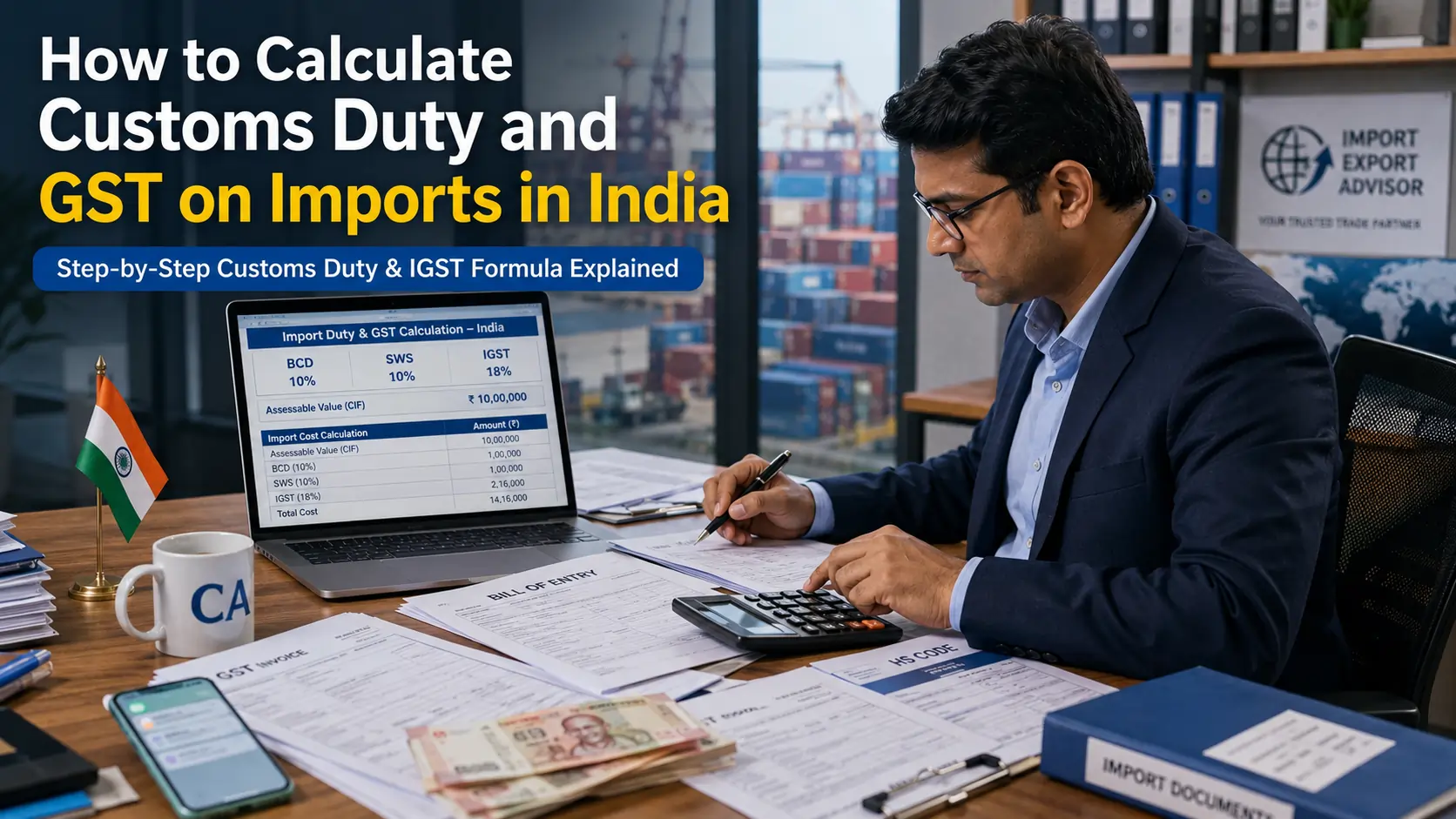
CUSTOMS DUTY CALCULATION FORMULA (INDIA 2026)
Step 1: Assessable Value (AV) = CIF Value in INR
Step 2: BCD = AV x BCD Rate%
Step 3: SWS = BCD x 10%
Step 4: IGST Base = AV + BCD + SWS
Step 5: IGST = IGST Base x IGST Rate%
Step 6: Total Import Cost = AV + BCD + SWS + IGST + Port/CHA charges
Step 1 - What Is Assessable Value in Customs Duty India?
The assessable value in customs duty India is the CIF (Cost + Insurance + Freight) value of goods, expressed in INR. CBIC publishes a fortnightly exchange rate notification - use that rate, not your bank's daily rate, for the USD-to-INR conversion.
Formula: Assessable Value = CIF Value x CBIC Exchange Rate
Step 2 - Basic Customs Duty (BCD)
BCD is your starting levy. Look up your product's HS Code in India's Customs Tariff to find the correct BCD rate. BCD = Assessable Value x BCD Rate% - simple multiplication, but only valid if you have the right HS Code.
Step 3 - Social Welfare Surcharge (SWS)
The social welfare surcharge on customs duty India equals 10% of BCD - not 10% of the assessable value. This distinction matters: SWS = BCD x 10%. For gold and silver, SWS drops to 3%. Always verify the notification for your specific goods.
Step 4 and Step 5 - How Is IGST Calculated on Imports in India?
This is where most importers make errors. For BCD and IGST difference on imports India: BCD uses the assessable value as its base. IGST uses a HIGHER base - the assessable value PLUS BCD PLUS SWS.
IGST Base = Assessable Value + BCD + SWS
IGST = IGST Base x IGST Rate (5% / 12% / 18% / 28% depending on HSN code)
So when you calculate customs duty and GST on imports in India, IGST applies on a compounded base - not just the invoice value. The government intentionally structures it this way so the overall GST burden aligns with what a domestic buyer of the same goods would pay.
Also Read: GST Changes from April 2026: What Every Business Must Know Before the Deadline
Real-World Example - Customs Duty Calculator India 2026 with Formula
Let us use a practical example. You import mechanical hand tools from China. Here are the assumptions:
- CIF Value: USD 5,000
- CBIC Exchange Rate: Rs. 83 per USD
- BCD Rate: 10% (as per HS Code)
- SWS: 10% of BCD
- IGST Rate: 18%
| Step | Component | Calculation | Amount (Rs.) |
| 1 | Assessable Value (AV) | USD 5,000 x Rs. 83 | Rs. 4,15,000 |
| 2 | Basic Customs Duty (BCD @ 10%) | Rs. 4,15,000 x 10% | Rs. 41,500 |
| 3 | Social Welfare Surcharge (SWS @ 10%) | Rs. 41,500 x 10% | Rs. 4,150 |
| 4 | IGST Base | Rs. 4,15,000 + Rs. 41,500 + Rs. 4,150 | Rs. 4,60,650 |
| 5 | IGST (@ 18%) | Rs. 4,60,650 x 18% | Rs. 82,917 |
| 6 | Total Duties Payable | BCD + SWS + IGST | Rs. 1,28,567 |
| 7 | Total Import Cost | AV + All Duties | Rs. 5,43,567 |
Key takeaway: On a USD 5,000 shipment at 10% BCD and 18% IGST, your total duty burden comes to over 30% of CIF value. This is why you must calculate customs duty and GST on imports in India accurately before finalising pricing or supplier negotiations.
Also Read: IEC Registration in India 2026 – Complete Step-by-Step Guide
4. Common Mistakes Importers Make (And How to Avoid Them)
After working with import-export businesses across India, these are the six most frequent errors - especially among first-time importers:
- Using the wrong HS Code: HS Code classification determines your BCD rate, IGST rate, and exemption eligibility. A wrong code triggers either overpayment or a customs violation notice. Always confirm your HSN with a CA for import export business India or a licensed customs house agent.
- Skipping the SWS calculation: The social welfare surcharge on customs duty India adds 10% on top of BCD. On large-value shipments, ignoring this surcharge significantly distorts your landed cost estimate.
- Applying IGST on CIF value alone: The question "how is IGST calculated on imports in India" has one answer: on AV + BCD + SWS - not just AV. Applying IGST only on the CIF value overstates your expected ITC.
- Missing import duty exemption India 2026 notifications: CBIC issues frequent exemption and concessional-duty notifications. Some raw materials, life-saving drugs, and FTA-covered goods qualify for BCD waiver or reduced rates. Not checking these means paying more than legally required.
- Importing without IEC: Every importer needs a valid Import Export Code from DGFT before the first shipment. Delays in IEC registration hold up the entire consignment. A reliable IEC registration consultant Bhopal can get your IEC issued in 1-2 working days.
- Losing IGST ITC due to documentation gaps: IGST paid at customs is fully creditable under GST - but only if your GSTIN appears on the Bill of Entry and your GSTR-2B data matches. Any mismatch triggers a GST notice.
Need a customs duty calculation for your specific goods?
CA Yash Garg - Import Export Consultant in Madhya Pradesh - offers free initial consultations for importers and exporters. Whether you need accurate customs duty calculation in India, HS Code advice, IEC registration, or full GST compliance support - get the right answer before your shipment arrives.
Call / WhatsApp: +91-7354928295 | cayashgarg.com
How to Claim ITC on Import GST Paid
One of the most searched questions from Indian importers: can I claim ITC on import GST paid? Yes - and the process is more straightforward than most people realise, as long as your documentation is clean.
Here is the complete GST on imports input tax credit claim process:
- Pay IGST at customs: At the time of import clearance, you pay IGST as part of your customs duty. The Bill of Entry (BoE) records this payment.
- Put your GSTIN on the Bill of Entry: The BoE must carry your GSTIN. Without it, IGST credit does not flow into your GST portal.
- IGST auto-appears in GSTR-2B: CBIC shares BoE data directly with GSTN. Your import IGST automatically populates in GSTR-2B under "Import of Goods" - no manual entry needed.
- Claim in GSTR-3B: Report import IGST in Table 4A(1) of your GSTR-3B for the same month as the BoE filing date.
- Offset against output tax: Use this IGST credit to set off your output IGST first, then CGST and SGST - in that prescribed order.
Important: ITC is unavailable on IGST paid for goods used in exempt supplies or personal consumption. Your import GST registration consultant must ensure BoE details match your GST records exactly to avoid GSTN mismatch notices.
Tip for Madhya Pradesh businesses: If your GST registration is in Bhopal or anywhere in MP, your import IGST credit flows into the same GST portal. You do not need a separate state registration for imports - but every Bill of Entry must carry your correct GSTIN.
Also Read : How to Start Export Business in India 2026
Frequently Asked Questions (FAQs)
These FAQs are structured to match Google People Also Ask results and AI search queries (ChatGPT, Gemini, Claude, Perplexity) for customs duty and GST on imports in India.
Q1. How is IGST calculated on imports in India with example?
IGST on imports is calculated on a compounded base: Assessable Value + BCD + SWS. Example: AV = Rs. 4,15,000 | BCD (10%) = Rs. 41,500 | SWS (10% of BCD) = Rs. 4,150 | IGST Base = Rs. 4,60,650 | IGST at 18% = Rs. 82,917. Total import cost = Rs. 5,43,567. This is the standard step by step customs duty calculation India formula.
Q2. What is assessable value in customs duty India?
The assessable value in customs duty India is the CIF (Cost + Insurance + Freight) value of imported goods converted to INR using CBIC's notified exchange rate. It is the base on which BCD is calculated - not just the invoice price.
Q3. What is the formula to calculate IGST on imports India?
Formula: IGST = (Assessable Value + BCD + SWS) x IGST Rate. The critical point is that IGST does not apply on CIF value alone - it applies on the total of AV + BCD + SWS. This is the formula to calculate IGST on imports India correctly.
Q4. Can I claim ITC on import GST paid?
Yes. GST on imports input tax credit claim is permitted under Section 16 of the IGST Act, 2017. The import IGST reflected in your GSTR-2B (auto-populated from the Bill of Entry) is claimable in GSTR-3B for the same period, subject to standard ITC conditions.
Q5. What is the social welfare surcharge on customs duty India?
Social Welfare Surcharge (SWS) is 10% of BCD on most goods. For gold and silver, the SWS rate is 3%. It is not calculated on the assessable value - only on BCD. It forms part of the IGST computation base, so it indirectly increases your IGST too.
Q6. What is the difference between BCD and IGST on imports India?
BCD is a pure customs levy on the assessable value - it goes to customs revenue. IGST is a GST levy on a higher base (AV + BCD + SWS) - it is fully creditable against output GST. This BCD and IGST difference on imports India is why importers who claim ITC effectively recover the IGST portion.
Q7. Which goods have import duty exemption India 2026?
As of 2026, import duty exemptions cover select raw materials, life-saving medicines, certain agricultural inputs, and goods covered under FTAs with UAE, Australia, and ASEAN nations. CBIC notifications govern specific exemptions - always verify the current notification for your HS Code before assuming zero BCD.
Q8. What is anti-dumping duty vs Basic Customs Duty India?
BCD applies to all imports of a given product, regardless of origin. Anti-dumping duty targets goods from a specific country sold below fair market price, hurting Indian manufacturers. Both can apply to the same shipment. ADD rates are product and country-specific, published in separate CBIC notifications.
Q9. Do I need IEC registration to import in India?
Yes. Import Export Code (IEC) is mandatory for all importers and exporters in India, issued by DGFT. Customs authorities require a valid IEC for customs clearance. If you are in Bhopal or anywhere in Madhya Pradesh, an IEC registration consultant Bhopal can complete the process online in 1-2 working days.
Q10. What is the total import cost calculation India with BCD IGST SWS?
Total import cost = AV + BCD + SWS + IGST + port and CHA charges. Using the formula: Total = AV x (1 + BCD%) + (AV x BCD% x 10%) + [(AV + BCD + SWS) x IGST%]. At 10% BCD + 18% IGST, this adds over 30% to your CIF value - a figure every importer must factor into pricing.
Conclusion - Get Your Import Costs Right Every Time
Knowing how to calculate customs duty and GST on imports in India is not just a compliance checkbox - it is a competitive advantage. Importers who master this formula negotiate better supplier prices, set accurate selling prices, and eliminate costly surprises at the port.
The formula is consistent: Assessable Value + BCD + SWS = IGST Base. Add IGST to get total duty. Add total duty to AV for landed cost. What changes across shipments is the HS Code, the applicable rates, and available exemptions.
For importers in Bhopal and Madhya Pradesh, working with a qualified customs duty consultant in Bhopal who understands both customs classification and GST ITC recovery gives you accuracy and peace of mind - especially when duty rates change through CBIC notifications mid-year.
CA Yash Garg - customs duty consultant India and import export consultant in Madhya Pradesh - has helped businesses across Bhopal, Indore, and pan-India with customs duty calculation, IEC registration, and import GST compliance.
Ready to simplify your import business?
Whether you need a customs duty calculation, IEC registration in Bhopal, GST compliance for imports, or a trusted CA for import export business India - CA Yash Garg is here.
Free Initial Consultation Available
Website: cayashgarg.com
Disclaimer: This blog is for general educational and informational purposes only. Customs duty rates, exemptions, and IGST rates change through CBIC notifications. Verify current rates with a qualified professional before making import decisions.