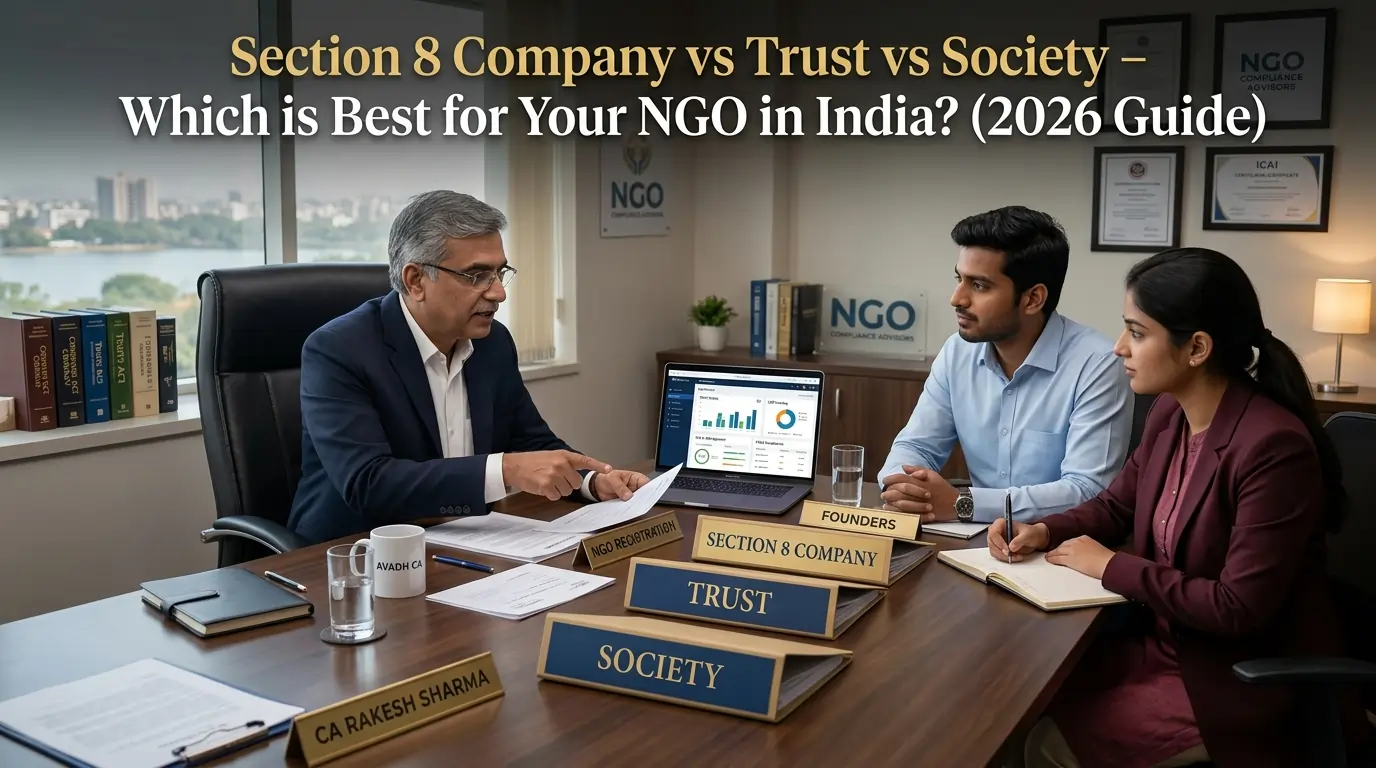
Section 8 Company vs Trust vs Society – Which is Best for Your NGO in India? (2026 Guide)
Starting an NGO in India is a noble step - but choosing the wrong legal structure can cost you years of rework, lost funding opportunities, and unnecessary compliance headaches. The three most popular NGO structures are Section 8 Company, Trust, and Society - and each one works differently when it comes to registration, governance, funding, and tax exemptions.
In this 2026 guide, we break down the section 8 company vs trust vs society debate in plain, simple language. Whether you are a first-time NGO founder or a social entrepreneur exploring your options, this guide will help you make the right decision - fast.
What Are the Three NGO Structures in India?
India has no single law for NGOs. Instead, three separate legal frameworks allow you to register a non-profit organisation, each governed by a different law:
- Section 8 Company - governed by the Companies Act 2013, regulated by the Ministry of Corporate Affairs (MCA)
- Trust - governed by the Indian Trusts Act 1882, registered with the Charity Commissioner or Sub-Registrar
- Society - governed by the Societies Registration Act 1860, registered with the Registrar of Societies in each state
Understanding the difference between trust, society, and section 8 company is the first step before you register your NGO. Let us look at each structure in detail.
What is a Section 8 Company?
A Section 8 Company is a special type of company registered under Section 8 of the Companies Act 2013. It is incorporated with the purpose of promoting charitable objects such as education, art, science, religion, social welfare, or environmental protection - without distributing profits to its members.
Think of it as a non-profit company India. It has all the features of a private or public limited company - a board of directors, Memorandum of Association (MOA), Articles of Association (AOA) - but with a strict no-profit-distribution clause.
Key Features of Section 8 Company
- Limited liability for directors and members
- Regulated by the Registrar of Companies (ROC) under MCA
- High credibility - preferred for CSR funds eligibility and foreign grants
- Eligible for 12A registration and 80G registration for tax exemptions
- Can apply for FCRA registration NGO for foreign donations
- Governed by a formal board of directors section 8 structure
Section 8 Company Registration Process
The registration process for a section 8 company in India involves the following steps:
- Obtain Digital Signature Certificate (DSC) for proposed directors
- Apply for Director Identification Number (DIN)
- File SPICe+ form on the MCA portal for name reservation and incorporation
- Prepare and submit MOA and AOA with charitable objects clause
- Obtain licence under Section 8 from ROC
- Apply for PAN, TAN, and bank account
- Apply for 12A registration and 80G registration using Form 10A (provisional) and Form 10AB (regular)
Section 8 Company Annual Compliance Requirements
Section 8 companies carry higher compliance obligations than trusts or societies:
- ROC annual filing: MGT-7 (Annual Return), AOC-4 (Financial Statements)
- Annual Board Meetings and statutory meetings
- Audited accounts filed with ROC each year
- Income tax return filing including Form 10B for 12A compliance
- FCRA annual return (if FCRA registered)
The section 8 company annual compliance cost India is higher than a trust or society, but the credibility it offers makes it worth it for most serious NGOs.
What is a Trust?
A Public Charitable Trust is the oldest and most common NGO structure in India. It is a legal arrangement where a trust deed is created between the founders (called trustees) to hold assets and apply them for a charitable purpose. It is governed by the Indian Trusts Act 1882 at the central level, though most states have their own Public Trust Acts.
Key Features of a Public Charitable Trust
- Simple to form - only 2 trustees required (minimum)
- Governed by a trust deed - the founding document
- Registered with the Charity Commissioner or Sub-Registrar depending on the state
- Eligible for 12A registration income tax and 80G registration donors benefits
- Suitable for smaller, family-run philanthropic initiatives
- Lower registration cost compared to a section 8 company
Trust Registration Process in India
Here is how trust registration in India typically works for an NGO:
- Draft the Trust Deed with charitable objectives, trustee names, and governing rules
- Present the Trust Deed before the Sub-Registrar / Charity Commissioner (varies by state)
- Pay applicable stamp duty on the Trust Deed
- Obtain registration certificate
- Apply for 12A and 80G registrations under the Income Tax Act 2025 provisions
Trust Annual Compliance Requirements
- Filing of income tax return each year
- Renewal or re-validation of 12A and 80G under the new rules
- Accounts maintenance as per Charity Commissioner's requirements (state-specific)
- FCRA annual return (if applicable)
Compared to a section 8 company, a trust has lower compliance burden - but it also has lower credibility in the eyes of corporate donors and foreign funding bodies.
What is a Society?
A Society is a membership-based non-profit structure registered under the Societies Registration Act 1860. It is commonly used for clubs, associations, cultural organisations, and NGOs focused on community causes. A society is run by a governing body elected by its members.
Key Features of a Society
Requires a minimum of 7 members to form
- Governed by a Memorandum of Association and Rules & Regulations
- Democratic structure - members elect the governing body
- State-level registration with the Registrar of Societies
- Eligible for 12A registration and 80G registration
- Good for community-driven causes and membership organisations
Society Registration Process in India
- Draft Memorandum of Association with the society's name and objects
- Draft Rules & Regulations governing the society's functioning
- Gather signatures of at least 7 founding members
- Submit application to the Registrar of Societies in your state
- Obtain registration certificate and apply for 12A/80G
Society Annual Compliance Requirements
- Filing of annual list of managing committee members with Registrar
- Annual general body meeting of members
- Income tax return and Form 10B filing
- FCRA annual return (if applicable)
Also Read: IEC Registration in India 2026 – Complete Step-by-Step Guide
Difference Between Trust Society and Section 8 Company - Complete Comparison Table
Here is the most comprehensive section 8 company vs trust vs society comparison table to help you understand each structure at a glance:
| Feature | Section 8 Company | Trust | Society |
| Governing Law | Companies Act 2013 | Indian Trusts Act 1882 | Societies Registration Act 1860 |
| Registration Authority | Registrar of Companies (ROC) | Charity Commissioner / Sub-Registrar | Registrar of Societies |
| Min. Members / Founders | 2 Directors (Private) / 3 (Public) | 2 Trustees (minimum) | 7 Members (minimum) |
| Governing Document | MOA + AOA | Trust Deed | Memorandum + Rules & Regulations |
| Liability | Limited | Unlimited (generally) | Unlimited (generally) |
| Transparency / Credibility | Very High (MCA regulated) | Moderate | Moderate |
| CSR Funding Eligibility | High - preferred by corporates | Moderate | Moderate |
| FCRA Registration Ease | Easier (ROC compliance record) | Possible, more scrutiny | Possible, more scrutiny |
| 12A / 80G Registration | Applicable | Applicable | Applicable |
| Annual Compliance | High (ROC filings required) | Low to Moderate | Moderate |
| Cost of Registration | Moderate to High | Low | Low |
| Amendment of Objectives | Requires ROC approval | Requires court approval | Requires member resolution |
| Best Suited For | Structured NGOs, CSR, FCRA | Family/private philanthropy | Community/member-driven causes |
Which NGO Structure is Best for CSR Funding?
Which NGO Structure is Best for CSR Funding?
If your goal is to attract CSR funds from companies, then a Section 8 Company is almost always the best choice. Here is why:
- Corporate donors trust Section 8 Companies more because they are regulated by the MCA - an established central government authority.
- Many large companies explicitly require that their CSR partners be either a Section 8 Company or a registered society/trust with a strong track record and valid 80G registration.
- The structured board of directors section 8 model aligns better with corporate governance expectations.
- ROC compliance creates an auditable paper trail that corporates look for when evaluating CSR funds eligibility.
Trusts and societies can receive CSR funds too - but they face more scrutiny and often require additional documentation to prove credibility. For serious CSR-funded NGOs, the section 8 company registration India route is the clear winner.
Also Read : 12A and 80G Renewal [Form 10AB] – Complete Guide 2026
Which NGO Structure is Best for FCRA Foreign Funding?
Section 8 Company vs Trust for Foreign Funding FCRA
If you plan to receive foreign donations, you will need to register under FCRA (Foreign Contribution Regulation Act). The good news is that all three structures - Section 8 Company, Trust, and Society - can apply for FCRA registration NGO. However, there are practical differences:
- Section 8 Companies have a stronger track record of getting FCRA approval because the MCA compliance records (ROC filings) serve as proof of active governance and financial discipline.
- Trusts can get FCRA - but approvals may take longer if their compliance history is thin or documentation is weak.
- Societies also qualify for FCRA but face similar challenges as trusts in terms of documentation scrutiny.
The Ministry of Home Affairs (MHA) looks at your NGO's governance history before granting FCRA. A section 8 company - with its ROC filings and MCA-regulated structure - typically makes a stronger case for foreign donation NGO India approvals.
Section 8 Company vs Trust - Cost and Compliance Comparison
Section 8 Company vs Trust Compliance Requirements
Here is how the two most popular structures compare on cost and compliance:
| Factor | Section 8 Company | Trust |
| Registration Cost | ₹5,000 – ₹15,000+ (govt fees + professional) | ₹500 – ₹3,000 (stamp duty + fees) |
| Registration Time | 15 – 30 working days | 7 – 15 working days |
| Annual Compliance Cost | ₹15,000 – ₹40,000+ | ₹5,000 – ₹15,000 |
| ROC Filing Required | Yes (MGT-7, AOC-4 mandatory) | No |
| Audit Required | Yes (always) | Only if income > ₹2.5 lakh |
| Amendment Flexibility | Requires ROC approval | Requires court/deed amendment |
| Perceived Credibility | Very High | Moderate |
Bottom line: If budget is your primary concern, start with a Trust. But if you are serious about scaling your NGO, attracting CSR or foreign funding, and building institutional credibility - invest in a section 8 company registration India.
April 2026 Update - RNPO Framework and What Changes for NGOs
RNPO Registration 2026 NGO India
One of the most significant developments for NGOs in 2026 is the roll-out of the RNPO (Registered Non-Profit Organisation) framework under the proposed Income Tax Act 2025. Here is what you need to know:
- RNPO Registration is a new unified compliance identity for NGOs - whether they are a Section 8 Company, Trust, or Society.
- All existing NGOs holding 12A registration and 80G registration will need to migrate or re-register under the RNPO framework as the Income Tax Act 2025 comes into full effect.
- The Form 10A (provisional) and Form 10AB (regular) registration processes are being rationalised under the new regime.
- NGOs receiving foreign contributions must ensure FCRA registration is current - the RNPO framework does not replace FCRA compliance.
If you are registering a new NGO in 2026, work with a qualified CA who understands both the section 8 company vs trust vs society distinction AND the new RNPO compliance requirements.
Also Read : When Can 12A Registration Be Cancelled?Reasons & How to Avoid It
Which NGO Structure Should You Choose? - Decision Guide
Still confused about which structure to pick? Here is a quick decision framework:
| Your Goal / Situation | Recommended Structure |
| I want maximum credibility and CSR funding | Section 8 Company |
| I want to receive foreign donations (FCRA) | Section 8 Company (preferred) / Trust or Society (possible) |
| I want a simple, low-cost setup for a small charity | Trust |
| I am running a community or member-based organisation | Society |
| I want to convert my trust to a more credible structure | Convert to Section 8 Company |
| I want to apply for 12A and 80G | Any - Section 8, Trust, or Society |
FAQ - Section 8 Company vs Trust vs Society
Q: Which is better - trust or section 8 company for a small NGO?
For a small NGO with limited budget, a Trust is simpler and cheaper to set up. However, if you plan to scale, seek CSR funding, or apply for FCRA, a Section 8 Company will serve you much better in the long run. The section 8 company vs trust decision depends on your growth ambitions.
Q: What is the minimum number of members required for a section 8 company, trust, and society?
A Section 8 Company requires at least 2 directors (for a private structure) or 3 (for a public structure). A Trust needs a minimum of 2 trustees. A Society requires at least 7 founding members under the Societies Registration Act 1860.
Q: How to convert a trust to a section 8 company in India?
Converting a trust to a section 8 company is not a straightforward statutory conversion - it generally involves dissolving the trust and incorporating a new section 8 company, then transferring the assets and activities. A qualified CA or legal expert familiar with NGO registration options in India can guide you through this process.
Q: What is the difference between a trust and a society in India?
The key difference between a trust and a society in India lies in their structure and governing law. A Trust (Indian Trusts Act 1882) is controlled by trustees who hold the assets. A Society (Societies Registration Act 1860) is membership-based with a governing body elected by members. Trusts are more private and flexible; societies are more democratic.
Q: Can a section 8 company apply for both 12A and 80G registration?
Yes. All three structures - Section 8 Company, Trust, and Society - can apply for 12A registration (tax exemption for the NGO) and 80G registration (tax deduction for donors). You file using Form 10A for provisional registration and Form 10AB for regular registration under the Income Tax Act provisions.
Q: Which NGO structure is best for FCRA foreign funding?
A Section 8 Company is generally the best NGO structure for FCRA foreign funding because its MCA-regulated compliance history strengthens the FCRA application. Trusts and societies can also get FCRA registration but may face more documentation scrutiny.
Q: What is the section 8 company annual compliance cost in India?
The section 8 company annual compliance cost in India typically ranges from ₹15,000 to ₹40,000 or more per year, depending on the CA's fees, the complexity of ROC filings (MGT-7, AOC-4), and whether FCRA returns are also required. This is higher than a trust or society.
Need Help Registering Your NGO in Bhopal, Vidisha, Sehore or Raisen?
If you are based in Madhya Pradesh and looking for expert guidance on section 8 company registration in Bhopal, 80G registration in Vidisha, or NGO registration in Sehore or Raisen, our team at CA Yash Garg is here to help.
We specialise in:
- Section 8 company registration in Bhopal - end-to-end MCA filing and ROC compliance
- NGO registration CA Bhopal - trust, society, and section 8 company structures
- 12A and 80G registration - provisional (Form 10A) and regular (Form 10AB)
- FCRA registration assistance for foreign donation eligibility
- RNPO registration guidance under the 2026 framework
- NGO registration across Madhya Pradesh - Bhopal, Vidisha, Sehore, Raisen, and surrounding areas
Whether you are choosing between a section 8 company vs trust or need help with a specific NGO registration consultant in Sehore or section 8 company CA in Raisen, reach out to us today for a free consultation.
Contact CA Yash Garg -
Visit cayashgarg.com for expert NGO registration support in Bhopal and across Madhya Pradesh.
Conclusion
Choosing between a section 8 company vs trust vs society is one of the most important decisions you will make as an NGO founder. Here is the quick summary:
- Section 8 Company - Best for credibility, CSR funding, FCRA, and large-scale NGOs
- Trust - Best for small, family-run, or private philanthropic initiatives
- Society - Best for community, cultural, or membership-driven organisations
All three structures can get 12A registration and 80G registration - and all three are eligible for FCRA. But if you want the strongest foundation for your NGO's future, the section 8 company route offers unmatched governance, credibility, and funding access.
In 2026, with the RNPO framework and Income Tax Act 2025 changes rolling in, getting expert help is more important than ever. Do not delay - reach out to a qualified NGO registration CA in Bhopal or across Madhya Pradesh to get started today.