GST Compliance Guide for Businesses and Startups in India (2026) – Complete Step-by-Step
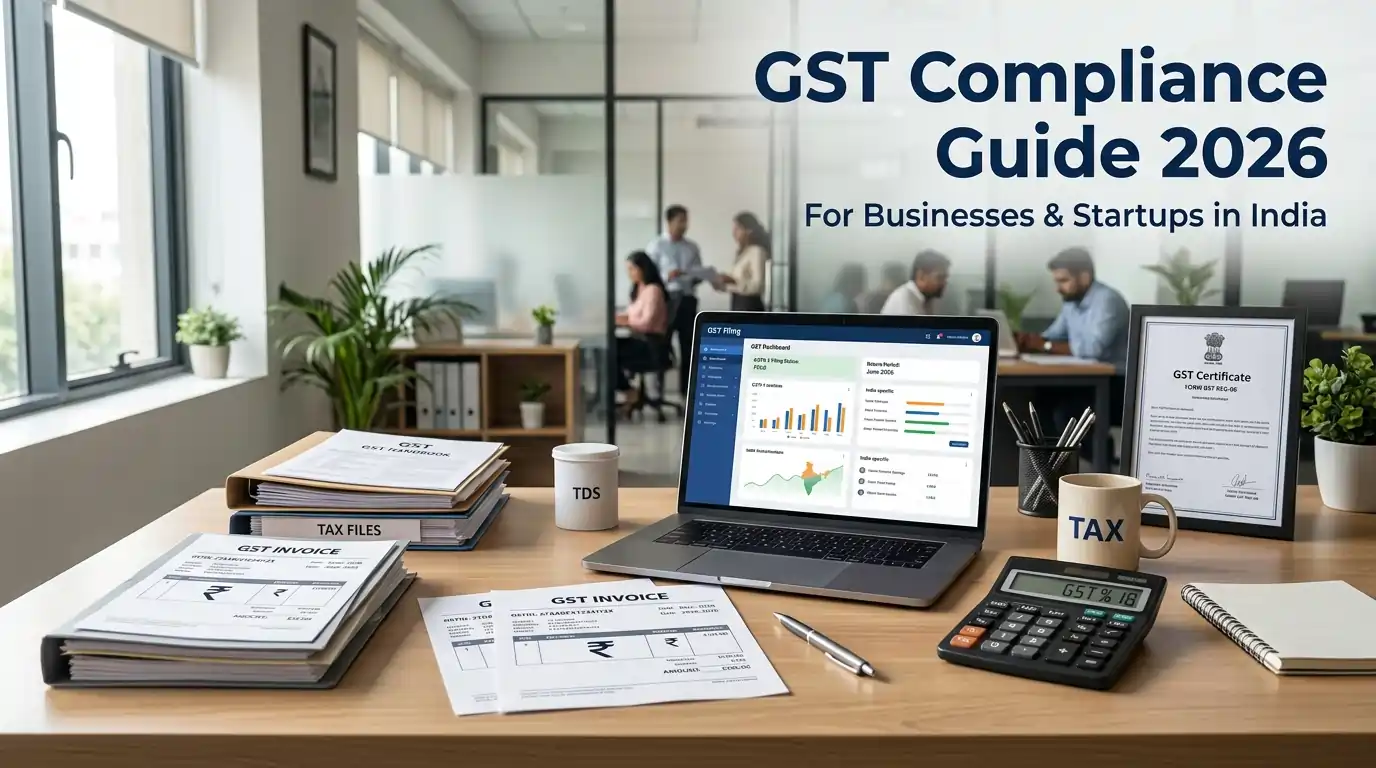
Running a business in India today means dealing with one question more than almost any other - GST. Whether you just registered your startup or have been running a small business for years, the rules around Goods and Services Tax keep changing, and staying compliant is no longer optional. Every late filing, missed return, or incorrect invoice can cost you real money, block your GSTIN, or trigger a government notice. This GST compliance guide for businesses and startups is written to give you a clear, step-by-step understanding of what GST compliance actually means in 2026.
We have covered everything - from registration and return filing to input tax credit, invoice rules, and what happens if you miss a deadline. No confusing legal language. No complicated jargon. Just practical information you can act on today.
Whether you are a startup founder in Bhopal, an SME owner, a freelancer, or running a growing company - this guide is written for you. Read it once, bookmark it, and come back every time you have a GST-related question.
What is GST Compliance - And Why Every Business Owner Must Know It
GST compliance simply means following all the rules set under the Goods and Services Tax law in India. This includes registering your business under GST when required, issuing proper invoices, filing your returns on time, paying the tax you owe, and keeping your financial records accurate and updated throughout the year.
When business owners talk about being 'GST compliant,' they mean they are doing all of these things correctly and consistently - not just once, but every single month throughout the financial year.
The GSTR-1 GSTR-3B filing deadlines, the rules for claiming Input Tax Credit, the e-invoicing format - all of these are part of being GST compliant. If you skip any one of these steps, you are technically non-compliant, and the consequences can range from a small daily fine to a serious legal notice from the tax department.
For any business operating in India in 2026, this GST compliance guide for businesses and startups is not just useful reading - it is essential knowledge. The GST system has become more digital, more automated, and far less forgiving of mistakes than it was even two years ago. The GSTN portal now uses AI-based matching to compare your filings and flag errors in real time. You simply cannot afford to treat GST as an afterthought anymore.
Also Read - Business Setup in India: Complete Registration & Compliance Guide
Why GST Compliance Matters More Than Ever for Startups in 2026
In 2026, GST compliance is not just about avoiding GST penalties for non-compliance India - it directly affects how your business operates every single day. Here is why it matters so much right now:
- Banks and investors now check your GST filing history before approving loans or considering funding. If your returns are inconsistent or you have gaps in your filing record, it raises serious red flags during due diligence. Many startups have lost funding opportunities simply because their GST compliance record was not clean or consistent.
- Your ability to generate e-way bills depends entirely on your GST status. If your returns are blocked or your GSTIN is suspended, you cannot generate e-way bills. This means goods cannot move - which can completely shut down your business operations without any warning.
- The GST system in 2026 is AI-powered and automated. The GSTN portal now automatically compares your GSTR-3B claims against your GSTR-2B data. Any mismatch gets flagged automatically and can lead to a notice or blocked ITC. Mistakes that may have gone unnoticed a few years ago are now caught within days.
- The e-invoicing mandate India businesses face has expanded significantly in 2026. What was once limited to large companies with high turnover now applies to businesses at a much lower threshold. The system checks compliance in real time, and non-compliant invoices are simply not accepted by buyers for ITC claims.
What is GST 2.0 and How Does It Impact Your Business?
GST 2.0 refers to the major set of reforms that came into effect in India from September 2025 onwards. The government simplified the tax slab structure - moving from the older complicated multi-rate system to a cleaner three-rate model. Most goods and services now fall under 5%, 18%, or 40% GST rates. The old 12% and 28% slabs have been largely phased out for most categories.
For businesses, this means you need to revisit your product pricing, check whether your HSN/SAC classifications have changed, and update your accounting software accordingly. If you are in retail, manufacturing, or e-commerce, there is a real chance some of your products have moved to a different slab - and continuing to charge the old rate is a compliance violation.
Is Your GSTIN at Risk of Suspension? - New Bank KYC Rule
One of the most important and often-overlooked changes in 2026 is that your GST registration is now directly linked to your bank account details on the portal. If your bank account is not verified or if the name on your bank account does not match your GST registration, your GSTIN can be automatically suspended by the system.
A suspended GSTIN means you cannot file returns, cannot generate e-way bills, and cannot do any formal business transactions. The fix is straightforward - log into the GST portal, go to your profile, and verify your bank account details immediately if you have not done so already.
Who Needs GST Registration in India - Is It Mandatory for Startups?
One of the most common questions from new business owners is whether is GST registration mandatory for startups below 20 lakh turnover - and the honest answer is: it depends on your specific business type, location, and how you sell.
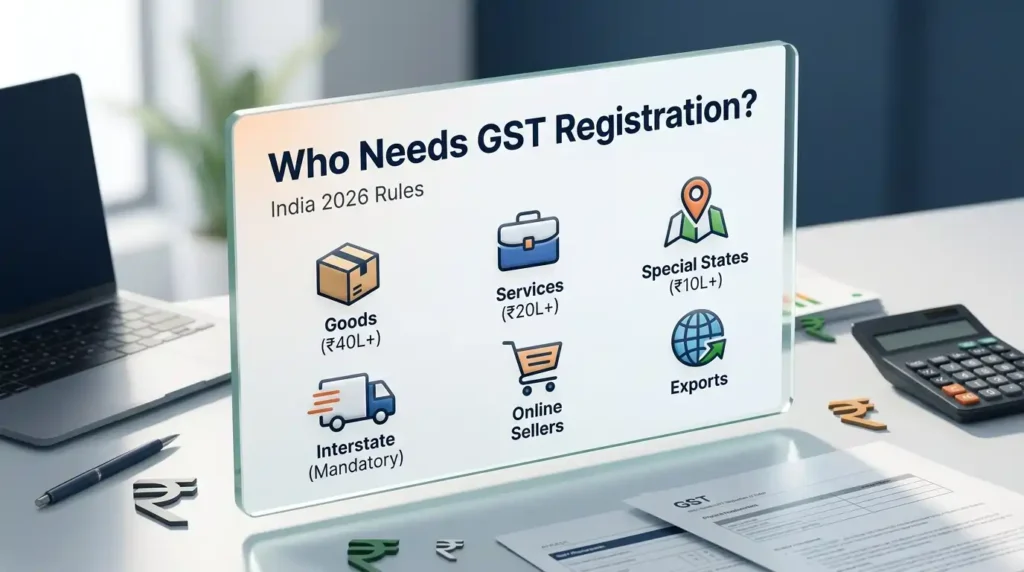
Here is a simple, clear breakdown of the registration thresholds:
| Business Type | Mandatory GST Registration Threshold |
| Goods supplier - most states | Annual turnover above ₹40 lakh |
| Service provider - most states | Annual turnover above ₹20 lakh |
| Special category states (NE, Hill states) | Annual turnover above ₹10 lakh |
| Interstate supplier - any turnover | Mandatory regardless of turnover |
| E-commerce seller - any platform | Mandatory regardless of turnover |
| Export business | Mandatory regardless of turnover |
| Casual taxable person | Mandatory before starting business activity |
So if your startup is selling products online on Amazon, Meesho, or Flipkart, you need GST registration from day one - even if your monthly revenue is only ₹5,000. The same applies if you are supplying goods or services to customers in another state, since any interstate supply requires mandatory GST registration process for startups India regardless of how small your turnover is.
Which Businesses Are Generally Exempt from GST Registration?
Businesses that sell only exempt goods - like fresh vegetables, milk, eggs, or certain agricultural produce - generally do not need to register. Similarly, businesses that operate purely within one state and have turnover below the prescribed threshold are not required to register. Certain educational services and healthcare services are also outside the GST net.
However, even if you are below the threshold, voluntary registration can be a smart business decision - especially if your clients are registered businesses who need a valid GST invoice to claim ITC.
When Should a Startup Voluntarily Register for GST?
Consider voluntary registration when you are regularly dealing with GST-registered businesses who demand proper tax invoices, when you want to claim ITC on your own business purchases and reduce your tax cost, when you are scaling up fast and expect to cross the threshold within the next quarter, or when you are applying for government tenders where GST registration is often a requirement.
Also Read - Audit and Assurance Services Explained for Businesses in India
How to Complete GST Registration - Step-by-Step Process for New Businesses
Understanding how to do GST compliance for a new startup in India always starts with completing the registration correctly. Many businesses make avoidable mistakes at this step that create complications for months afterward. Here is the complete process from start to GSTIN approval:
- Go to the official GST portal at gst.gov.in and click on 'New Registration' under the Services menu. Enter your PAN, mobile number, email ID, and state to generate a Temporary Reference Number (TRN). You will receive OTPs on your phone and email - verify both to proceed.
- Complete Part A of the application with your basic business details - legal name of the business as per PAN, trade name (if different), and your primary contact details.
- Fill Part B with full business information - this is the detailed section where you enter your principal place of business address, HSN or SAC codes for your products and services, bank account details, and information about all business partners, directors, or promoters. Be very careful with HSN code selection. Wrong codes create mismatches and notices later.
- Upload all required documents - PAN card, Aadhaar card, photograph of the proprietor or authorized signatory, address proof of the business (rent agreement or property ownership document), and a recent bank statement or cancelled cheque.
- Complete Aadhaar e-KYC verification - in 2026 this is the standard verification method. Aadhaar-based verification allows faster approval and typically results in GSTIN approval within 3 to 7 working days.
- Track your Application Reference Number (ARN) on the portal and download your GST registration certificate once approved. Display it prominently at your place of business as required by GST law.
What Documents Are Required for GST Registration?
For a sole proprietorship: PAN card, Aadhaar card, recent photograph, address proof of business, and bank account details. For a private limited company or LLP: these same documents plus the Certificate of Incorporation, Memorandum of Association, and a board resolution authorizing the signatory.
How Long Does GST Registration Take in 2026?
With Aadhaar e-KYC, most applications are approved within 3 to 7 working days. However, if the GST officer raises a query or requests additional documents, it can take up to 30 days. Apply well in advance of when you need to start operations so registration delays do not hold back your business.
Which GST Returns Does Your Business Need to File - GSTR-1, GSTR-3B, GSTR-9 Explained
Once you are registered, GST return filing for small business becomes your most important recurring compliance task. Many business owners are genuinely confused about which returns they need to file and when. Let us break down each return in simple terms so there is no confusion.
What is GSTR-1 and When is it Due?
GSTR-1 is the return where you report all the sales invoices you have issued during the month - every B2B invoice, B2C invoice, export invoice, and any credit or debit notes. This is the data your buyers rely on to claim their Input Tax Credit, which is why accuracy in GSTR-1 is absolutely critical. If you upload a wrong invoice number or a wrong GSTIN, your buyer cannot claim ITC, which damages your business relationship.
For most monthly filers, GSTR-1 is due on the 11th of the following month. Quarterly filers under the QRMP scheme file it by the 13th of the month following the end of each quarter.
What is GSTR-3B and How is it Different from GSTR-1?
GSTR-3B is your summary return - it is where you declare your total GST collected on sales, total ITC available from purchases, and the net tax amount you owe to the government. GSTR-1 is invoice-level detail; GSTR-3B is the payment summary. Both must match each other, and the GSTN system now checks this alignment automatically.
The GSTR-1 GSTR-3B filing deadlines are the two dates every business owner should have permanently in their calendar. Missing GSTR-3B is particularly serious because it is directly linked to your tax payment obligation. A missed GSTR-3B triggers late fees, interest on outstanding tax, and blocks your buyers from claiming ITC on your invoices.
When Should a Small Business File GSTR-9 Annual Return?
GSTR-9 is the annual return filed once a year that consolidates all your monthly filings. If your turnover is above ₹2 crore, GSTR-9 is mandatory. Even if you are below this threshold, filing it voluntarily is strongly recommended - it creates a clean and complete compliance record that helps during bank loan applications, investor due diligence reviews, and government contract applications.
For businesses with turnover above ₹5 crore, a reconciliation statement in GSTR-9C is also required, which compares your books with your GST filings and must be certified by a Chartered Accountant.
Also Read - Benefits of Hiring an Outsourced Accountant
When is Your GST Return Due - Complete Filing Calendar for FY 2026-27
Knowing your GSTR-1 GSTR-3B filing deadlines and the full annual schedule is the most practical step you can take toward maintaining a clean GST compliance checklist India 2026. Here is the complete filing calendar for the current financial year:
| Return | Form | Who Files It | Due Date |
| Sales statement - monthly | GSTR-1 | Monthly filers | 11th of next month |
| Sales statement - quarterly | GSTR-1 (QRMP) | Quarterly filers | 13th after quarter end |
| Summary return + tax payment - monthly | GSTR-3B | Monthly filers | 20th of next month |
| Summary return - quarterly Cat I states | GSTR-3B (QRMP) | Quarterly filers (Cat I) | 22nd after quarter end |
| Summary return - quarterly Cat II states | GSTR-3B (QRMP) | Quarterly filers (Cat II) | 24th after quarter end |
| Annual return | GSTR-9 | Turnover above ₹2 crore | December 31, 2026 |
| Reconciliation statement | GSTR-9C | Turnover above ₹5 crore | December 31, 2026 |
| Composition taxpayer return | GSTR-4 | Composition scheme businesses | April 30, 2026 |
| Export letter of undertaking | Form RFD-11 (LUT) | Exporters | March 31 every year |
Set calendar reminders for each of these dates without exception. A single missed deadline on GSTR-3B can cost you ₹50 per day in late fees and block your buyers from claiming ITC on your invoices - which can seriously damage those business relationships.
How GST Compliance Differs for Startups vs Small Businesses - A Practical Comparison
Not all businesses face identical GST compliance requirements. As part of this GST compliance guide for businesses and startups, it is important to understand how the rules differ based on your business size and structure - because making the right scheme choice at the beginning can save you significant time, money, and paperwork every single month.
The most important decision for small businesses is whether to register under the regular GST scheme or opt for the GST composition scheme small business option. Here is a side-by-side comparison to help you decide:
| Feature | Regular GST Scheme | Composition Scheme |
| Who can use it | All registered businesses | Turnover up to ₹1.5 crore (goods) or ₹75 lakh (services) |
| Tax rate | Standard rates: 5%, 18%, 40% | Flat 1% to 6% on total turnover |
| Input Tax Credit available | Yes - claim ITC on purchases | No - ITC cannot be claimed |
| Can charge GST to customers | Yes - issue full tax invoice | No - only bill of supply |
| Return filing frequency | GSTR-1 + GSTR-3B monthly | GSTR-4 once a year |
| Interstate supply allowed | Yes | No - only intra-state supply |
| Best suited for | Startups, B2B businesses, exporters | Local retailers, restaurants, small traders |
Is the Composition Scheme Right for Your Small Business?
The composition scheme is ideal for small local businesses that deal mainly with end consumers (B2C), operate within a single state, have relatively simple transactions, and want to avoid the complexity of monthly return filing. The flat tax rate and annual return filing are genuinely attractive for very small businesses.
However, if you are a startup dealing primarily with other registered businesses (B2B), the composition scheme is not right for you. Your clients will be unable to claim ITC on your invoices, which makes you less attractive as a vendor compared to competitors who are on the regular scheme.
Which GST Scheme Works Best for Service-Based Startups?
For service-based startups - IT companies, consultants, digital agencies, freelancers - the regular GST scheme is almost always the better choice. The 18% GST on services under the regular scheme allows you to claim ITC on your own business expenses (software, office rent, marketing), which effectively reduces your overall tax cost. The composition scheme for services is capped at ₹75 lakh turnover and carries a 6% flat tax with no ITC - making it less efficient for most service businesses.
Also Read - Outsourced Accounting Services for SMEs and Startups in India
How to Claim Input Tax Credit - Where Startups Leave Money on the Table
Input tax credit for startups India is one of the most powerful features of the GST system - and one of the most misunderstood. ITC allows you to reduce the GST you need to pay to the government by the GST you have already paid on your business purchases. It essentially eliminates double taxation.
Understanding how to claim input tax credit for startup expenses India is crucial because many startups are unknowingly paying far more tax than they should. If you are paying 18% GST on your cloud server bills, software subscriptions, digital marketing, legal fees, or CA fees - all of that GST is eligible to be claimed back through ITC. Businesses that do not claim it are simply leaving money on the table every month.
Here is a simple example to show how ITC works in practice:
- You pay ₹1,00,000 + 18% GST on software subscriptions = ₹18,000 GST paid as input
- You earn ₹5,00,000 + 18% GST on your services = ₹90,000 GST collected from clients
- Your net GST payable = ₹90,000 minus ₹18,000 = only ₹72,000 - you save ₹18,000 in cash
The savings add up to lakhs annually for growing startups, especially those with significant expense on SaaS tools, cloud infrastructure, and professional services.
In 2026, ITC reconciliation GSTR-2B has become the most critical step in the ITC process. You can only claim ITC that appears in your GSTR-2B statement - which is automatically generated on the 14th of each month based on what your suppliers have uploaded in their GSTR-1. If a supplier has not filed their return on time, that invoice will not appear in your GSTR-2B, and you cannot claim ITC on it for that month.
What Expenses Are Eligible for ITC Claims in 2026?
Most legitimate business expenses that come with a GST invoice are eligible for ITC. These include office rent (if the landlord charges GST), business equipment and machinery, raw materials and components, digital marketing services, legal and accounting fees, software and SaaS subscriptions, logistics and freight, and IT infrastructure costs.
Blocked credits - expenses where you cannot claim ITC even if you have a valid GST invoice - include food and beverages for employees, personal vehicles, club memberships, outdoor catering, and any expenses used for personal rather than business purposes.
How Does the New IMS (Invoice Management System) Affect ITC?
The Invoice Management System (IMS) introduced in FY 2025-26 is a major change to how ITC is claimed. The system now requires you to actively log into the GST portal and either accept, reject, or mark as pending every invoice your suppliers upload. This is not automatic - it requires your active participation.
If you do not act on invoices in the IMS, your ITC claims can be affected. Make it a weekly routine to log into the portal, review pending invoices in IMS, and process them before your GSTR-3B filing date. Missing this step is one of the most common new compliance mistakes businesses are making in 2026.
Also Read - What is Bookkeeping and Why Every Business Needs It
What Are the GST Invoice Requirements in 2026 - E-Invoicing, IRN and QR Code Rules
Getting your invoices right is not just good practice - it is a legal requirement. The GST invoice requirements 2026 are more detailed than they used to be, especially with e-invoicing and the Invoice Reference Number (IRN) system now part of daily business operations for many companies.
Every GST tax invoice must include these mandatory fields:
- Your GSTIN and the buyer's GSTIN (for all B2B transactions - this cannot be left out)
- Invoice number and invoice date - invoice numbers must be sequential and unique within each financial year
- Six-digit HSN or SAC code for every product or service on the invoice - the requirement for six-digit codes now applies to most businesses
- Taxable value, applicable GST rate, and GST amount shown separately as CGST and SGST (for intra-state) or IGST (for inter-state)
- Place of supply - this determines whether the transaction is intra-state or inter-state, which affects which type of GST (CGST+SGST or IGST) applies
For the e-invoicing mandate India businesses must comply with in 2026, here is the current threshold structure:
| Annual Turnover (Previous FY) | E-Invoicing Required? |
| ₹5 crore and above | Yes - mandatory, must generate IRN for every B2B invoice |
| ₹10 crore and above | Yes - plus QR codes required on all B2B invoices |
| Below ₹5 crore | Not mandatory but recommended for smoother ITC flow |
Is E-Invoicing Mandatory for Your Business Based on Turnover?
Check your Aggregate Annual Turnover (AATO) for the previous financial year. If it was ₹5 crore or above, every B2B invoice you issue must be uploaded to the Invoice Registration Portal (IRP), which generates a unique Invoice Reference Number (IRN). Without the IRN, your invoice is not legally valid for ITC purposes - meaning your buyer cannot claim ITC on it, which creates immediate commercial problems.
What Happens if You Issue a Non-Compliant Invoice?
A non-compliant invoice - one missing an IRN, wrong HSN code, or incorrect GSTIN - can result in your buyer losing their ITC claim entirely, a GST notice under Section 122 with a penalty of up to ₹25,000 per error, and your GSTR-1 being automatically flagged for a mismatch by the GSTN system. Always use billing software that is GST-compliant and generates IRN automatically by integrating with the IRP.
GST Compliance Checklist for Businesses and Startups - 2026 Edition
Use this GST compliance checklist India 2026 as your practical monthly and annual action list. This is the summary every business needs to stay compliant without missing anything important:
Monthly Compliance Tasks:
- File GSTR-1 by the 11th - upload all your sales invoices with correct GSTIN, HSN codes, and amounts. Double-check B2B invoice details before uploading because errors affect your buyers' ITC.
- Download and reconcile your GSTR-2B by the 14th - compare it against your purchase register to identify missing invoices and ITC discrepancies before the GSTR-3B deadline.
- Process pending invoices in the IMS portal - accept invoices from compliant suppliers, reject invalid ones, and keep problematic ones pending for follow-up.
- File GSTR-3B and pay all outstanding GST by the 20th - claim only ITC that appears in your GSTR-2B, and ensure your tax payment is made on time to avoid interest charges.
- Generate e-way bills for all interstate goods movement above ₹50,000 - missing e-way bills on eligible shipments is one of the most common GST violations for goods-based businesses.
Annual Compliance Tasks:
- File GSTR-9 annual return by December 31, 2026 - this consolidates your full year of filings and helps identify any mismatches or unclaimed ITC.
- File GSTR-9C reconciliation statement (if turnover above ₹5 crore) - this must be prepared and certified by a Chartered Accountant.
- Renew your Letter of Undertaking (LUT) for export transactions by March 31 - without a valid LUT, your exports will attract IGST upfront, blocking your working capital.
- Review all HSN and SAC codes for your products and services - post-GST 2.0 reforms, some classifications have changed and using outdated codes creates compliance issues.
This GST compliance checklist for small businesses India 2026 is also something your CA should be reviewing with you at the start of every financial year to ensure nothing falls through the gaps.
What Happens If GST Returns Are Not Filed on Time - Penalties, Notices and GSTIN Suspension
This is a question every business owner needs a clear answer to: what happens if GST return is not filed on time? The short answer is - it gets expensive, fast. And in 2026, the system is automated enough that there is no grace period, no manual warning, and no second chance before fees start accumulating.
What is the Late Filing Fee for GSTR-3B?
The late fee for GSTR-3B is ₹50 per day for businesses that have any tax liability (₹25 CGST + ₹25 SGST), capped at ₹5,000 or 0.25% of your annual turnover - whichever is higher. For businesses with zero transactions (nil return filers), the fee is ₹20 per day. There is also interest at 18% per annum on any outstanding tax amount from the due date to the actual payment date.
Always file your GSTR-3B on time even if you have zero transactions that month. A nil return takes less than five minutes to file and costs nothing. The late fee for skipping it can be much more.
The full picture of GST penalties for non-compliance India:
| Violation | Penalty / Consequence |
| Late GSTR-3B filing | ₹50/day (nil filers ₹20/day), capped at ₹5,000 or 0.25% of turnover |
| Late GSTR-9 annual return | ₹200 per day, capped at 0.25% of turnover |
| Tax evasion - general | ₹10,000 or the tax evaded, whichever is higher |
| Incorrect invoice / missing data (Section 122) | Penalty up to ₹25,000 per error |
| Wrong ITC claim | Pay back the ITC plus 24% annual interest |
| Missing 3 consecutive monthly returns | GSTIN automatically suspended |
| Serious GST fraud above ₹5 crore | Prosecution and potential arrest under Section 132 |
Can Your GSTIN Be Cancelled for Non-Compliance?
Yes, absolutely. Missing three or more consecutive monthly GSTR-3B filings triggers an automatic GSTIN suspension in 2026. Once suspended, your GSTIN is completely non-functional - you cannot issue invoices, generate e-way bills, file returns, or receive GST refunds.
To revoke the suspension, you must file all pending returns, pay all outstanding tax dues plus interest and late fees, and then apply for revocation within 30 days of the suspension notice. The entire process takes time and money - far more than simply filing returns on time every month. Prevention is always the better strategy.
Also Read - Complete Guide to Accounting & Bookkeeping Services for Businesses in India
Where to Get Expert GST Compliance Services in Bhopal - CA Yash Garg
If you are looking for reliable GST compliance services in Bhopal, CA Yash Garg has been helping businesses, startups, SMEs, freelancers, and individuals stay fully compliant since 2015. Over a decade of hands-on experience means we have seen every GST situation - from first-time registrations to complex ITC disputes, e-invoicing setups, GST notice replies, and annual return reconciliations.
Whether you need help with registration, monthly return filing, ITC reconciliation, e-invoicing configuration, composition scheme evaluation, or responding to a GST notice - our team of expert CAs, Company Secretaries, and tax consultants handles everything from start to finish. We do not just file your returns - we make sure your entire GST compliance system is clean, accurate, and audit-ready at all times.
If you are searching for a trusted CA for GST filing in Bhopal, CA Yash Garg offers customized, transparent monthly packages for startups, growing businesses, and established companies - with 24/7 support, technology-driven processes, and the reliability that comes from working with a certified professional.
| Ready to Make GST Compliance Stress-Free? 📞 Call / WhatsApp: +91-735-492-8295 📧 Email: info@cayashgarg.com 🌐 Visit: cayashgarg.com CA Yash Garg | FCA, DISA, GST Certified by ICAI Bhopal, Madhya Pradesh - Serving Clients Across India & Internationally |
Frequently Asked Questions on GST Compliance for Businesses and Startups
Q1: Is GST registration mandatory for startups below 20 lakh turnover?
Not always. For service providers, the threshold is ₹20 lakh annually (₹10 lakh in special category states like NE India and certain hill states). For goods suppliers, the threshold is ₹40 lakh in most states. However, if your startup sells online across multiple states, supplies to e-commerce platforms, or makes any interstate supply, registration is mandatory from day one regardless of your turnover level.
Q2: How do I claim input tax credit for startup expenses in India?
Download your GSTR-2B statement on the 14th of each month from the GST portal. This shows all the invoices your suppliers have uploaded. Reconcile this against your own purchase records to match invoices. When filing GSTR-3B by the 20th, claim only the ITC amounts that appear in your GSTR-2B. Process pending invoices in the IMS portal before filing to ensure nothing is missed. Maintain digital records of all input invoices for at least 6 years.
Q3: What happens if my GST return is not filed on time?
Late fees start at ₹20 to ₹50 per day from the day after the due date. Interest at 18% per annum accrues on any unpaid tax. Your buyers lose the ability to claim ITC on your invoices, which damages your commercial relationships. After three missed consecutive returns, your GSTIN is automatically suspended - meaning your business effectively stops being able to operate formally.
Q4: What is the difference between GSTR-1 and GSTR-3B?
GSTR-1 is the invoice-level detail return where you upload every sales invoice you have issued during the month - including B2B invoices, B2C invoices, export invoices, and any credit or debit notes. GSTR-3B is the summary return where you declare your total tax liability and make the actual tax payment. Think of GSTR-1 as the details and GSTR-3B as the payment. Both must match, and the GSTN system checks this automatically in 2026.
Q5: Who should I contact for professional GST compliance support in Bhopal?
CA Yash Garg offers complete GST compliance services in Bhopal, covering registration, monthly return filing, ITC reconciliation, e-invoicing setup, GST notice handling, and annual return filing. With 10+ years of experience and certifications in GST from ICAI, our team provides dependable, accurate, and timely compliance support for businesses of all sizes. Reach out at +91-735-492-8295 or visit cayashgarg.com for a consultation.
Final Thoughts - GST Compliance is an Ongoing Commitment, Not a One-Time Task
GST compliance is not something you can set up once and forget. It is a continuous responsibility that requires attention every single month - from checking GSTR-2B reconciliation and processing IMS invoices, to filing GSTR-3B on time, managing ITC accurately, issuing correct e-invoices, and staying updated with the latest rule changes as GST continues to evolve in India.
This GST compliance guide for businesses and startups has covered everything you need to know - from understanding the basics to navigating the latest 2026 rule changes, the IMS portal, GST 2.0 slab restructuring, penalty structures, composition scheme decisions, and the full filing calendar. The businesses that treat GST compliance as a priority - not just an annual headache - are the ones that avoid costly notices, maintain investor confidence, secure loans more easily, and build a clean financial track record over time.
Start with the checklist in this guide. Set your filing reminders. Reconcile your GSTR-2B every month. And if you ever feel uncertain about a GST decision - whether it is about the right scheme, an ITC claim, an invoice format, or a government notice - consult a qualified Chartered Accountant before acting. The cost of professional advice is always lower than the cost of a compliance mistake.
| Need Help with GST Compliance? We Are Here for You. CA Yash Garg - Your Trusted CA for GST Filing in Bhopal Registration | Return Filing | ITC Reconciliation | Notice Handling | Annual Returns 📞 +91-735-492-8295 | 📧 info@cayashgarg.com | 🌐 cayashgarg.com |