
Company Registration in India: Step by Step Guide [2026]
You have a great idea. You know your market. You are ready to start. But before your business can open a bank account, sign a contract, or even hire its first employee - it needs to exist legally. That is where Company Registration in India comes in.
In India, business registration is governed by the Companies Act 2013, and the Ministry of Corporate Affairs (MCA) is the authority that handles all of it. The good news is that the entire process has moved online in recent years. You no longer need to visit government offices or wait in queues for weeks.
This guide walks you through everything - from choosing the right business structure, to getting your Certificate of Incorporation, to what you need to do right after. Whether you are a first-time founder, a professional setting up a firm, or a foreign national looking to start in India, this guide covers it all in plain, simple language.
What Is Company Registration in India and Why Is It Mandatory?
Company registration is the legal process of creating a business entity that is separate from its owners. Once registered, your company has its own legal identity - it can own assets, enter into contracts, sue and be sued, and even take on debt. You, as a director or shareholder, are protected from personal liability.
The process is governed by the Companies Act 2013, and all registrations in India go through the Registrar of Companies (ROC) under the Ministry of Corporate Affairs.
Now, is it mandatory? It depends on the structure you choose. Running as a sole proprietor does not require formal company registration. But if you want limited liability protection, the ability to raise investor funding, or the credibility of a proper legal entity - then company registration is the way to go.
Here is what happens if you operate without registration when you actually need it:
● You cannot claim limited liability - your personal assets are at risk if the business gets into trouble
● Banks may not open a current account in your company name without incorporation proof
● You cannot raise equity funding from investors or venture capitalists
● Government contracts and tenders often require proof of company registration
● Non-compliance penalties under the Companies Act 2013 can be significant
The bottom line - if you are serious about building a business that can grow, getting registered is not optional. It is the foundation.
Also Read - Business Setup in India: Complete Guide to Company Registration & Legal Compliance
Which Type of Company Should You Register in India?
This is the question most founders get confused about first. India has several business structures, and each one works differently in terms of compliance, taxation, and how you can grow. Picking the wrong one early can cost you money to fix later.

Here is a clear comparison of the most common options:
| Structure | Best For | Min. Members | Compliance | Funding |
| Private Limited | Startups, growing businesses, investor-ready ventures | 2 Directors, 2 Shareholders | High | Equity / VC allowed |
| LLP | Professionals, service firms, consultants | 2 Designated Partners | Medium | No equity funding |
| OPC | Solo founders wanting limited liability | 1 Director, 1 Shareholder | Medium | Limited |
| Sole Proprietorship | Very small / home businesses, freelancers | 1 Person | Low | No formal funding |
Private Limited Company - Best for Startups and Growing Businesses
A Private Limited Company (Pvt Ltd) is the most popular structure for startups and growing businesses in India. It gives you limited liability, a proper legal identity, and the ability to bring in investors. You need at least 2 directors and 2 shareholders to start one. It has more compliance requirements than an LLP, but if you plan to grow big, this is the structure that opens the most doors.
LLP vs Private Limited Company - Key Differences You Must Know
A Limited Liability Partnership (LLP) is a good fit for professionals - Chartered Accountants, lawyers, architects, consultants. It has lower annual compliance requirements compared to a Pvt Ltd company and works well for service-based businesses. The key limitation is that LLPs cannot issue shares or raise equity funding from outside investors. So if you are building a product startup and want to raise money from investors someday, a Pvt Ltd is almost always the better choice.
One Person Company (OPC) - For Solo Founders
If you are working alone and want the benefits of limited liability without needing a co-founder, an OPC is a good option. You can be the sole director and sole shareholder. It does come with some restrictions - for example, it cannot be converted to a section 8 company, and there are limits on paid-up capital and turnover before it must be converted to a Pvt Ltd.
Who Can Register a Company in India - Eligibility Requirements
One of the most common questions people ask is: who is actually allowed to register a company in India? The answer is broader than most people expect.
● Indian citizens - anyone above 18 years of age can become a director
● NRIs (Non-Resident Indians) - fully eligible to be directors and shareholders
● Foreign nationals - yes, foreigners can register and run a company in India, subject to FDI (Foreign Direct Investment) regulations and FEMA compliance
● Companies - another company (Indian or foreign) can also be a shareholder in an Indian company
For a Private Limited Company, you need at least 2 directors and 2 shareholders. One director must be an Indian resident (a person who has stayed in India for at least 182 days in the previous calendar year).
One important thing to clarify - there is no minimum paid-up capital requirement for registering a Pvt Ltd company in India. This is a common myth. You only need to decide on an "authorized capital" (the maximum share capital your company is allowed to issue), and even that can start at a nominal amount.
You will also need a registered office address in India - this is the official address that will appear on all MCA records and government correspondence.
Note for Foreign Investors: If you are a foreign national or a foreign company registering in India, FEMA regulations apply to your investment. This is a specialized area - consult CA Yash Garg before proceeding to ensure full compliance.
What Documents Are Required for Company Registration in India?
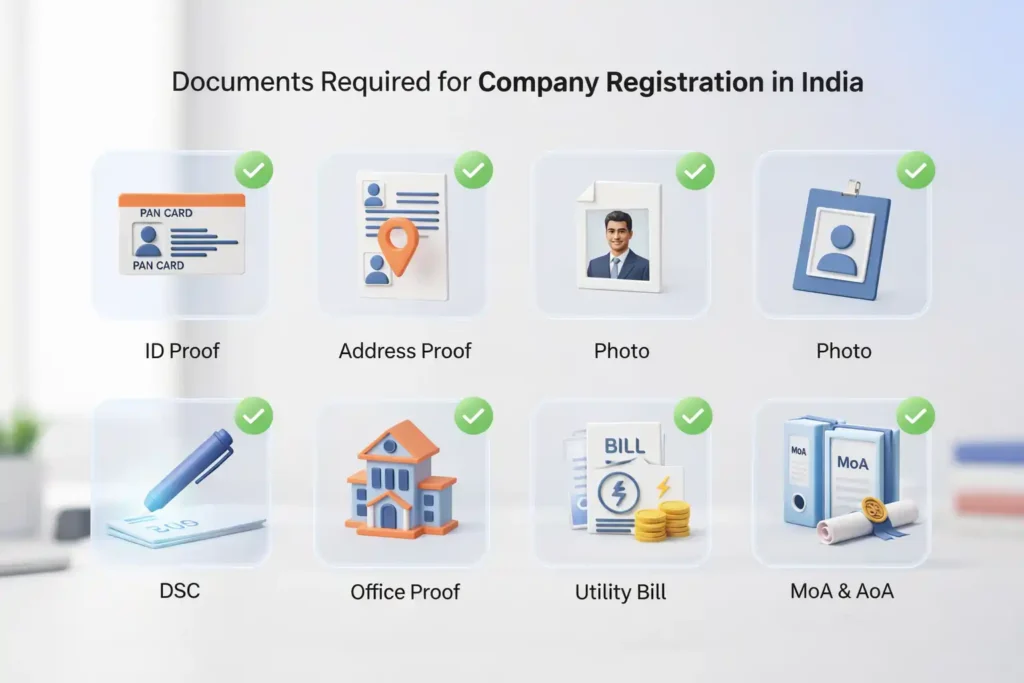
Before you start the online process on the MCA portal, gather all your documents. Missing even one document can cause delays or rejection of your application. Here is the complete list:
| Document Type | What You Need |
| Identity proof (Directors) | PAN Card (mandatory for Indian nationals) + Aadhaar Card or Passport |
| Address proof (Directors) | Bank statement or utility bill - must not be older than 2 months |
| Photograph | Recent passport-size photograph of each director |
| Digital Signature (DSC) | Required for all proposed directors to sign MCA forms electronically |
| Registered office proof | Rent agreement + NOC from property owner, OR own property documents |
| Utility bill (office) | Electricity or telephone bill of office - not older than 2 months |
| MoA & AoA | Memorandum of Association and Articles of Association - prepared by your CA |
A few things worth noting about these documents:
What is a Digital Signature Certificate (DSC) and Why Do You Need It?
The DSC is essentially your electronic signature. Since all MCA filings happen online, every director needs a DSC to sign documents digitally before submitting them. You apply for it through MCA-authorised certifying authorities, and it typically takes 1 to 2 working days to get. This is usually the very first thing you do - before anything else.
What Are MoA and AoA?
The Memorandum of Association (MoA) defines your company's name, its registered office state, the main objects (what your business does), and the liability of members. The Articles of Association (AoA) defines the internal rules of your company - how meetings will be held, how shares can be transferred, and how directors are appointed. Both are legal documents that your CA helps you draft correctly.
How to Register a Company in India: Step by Step Process
Here is the complete process for company registration in India on the MCA portal - broken down into clear steps so you know exactly what happens and in what order.
Step 1: Obtain a Digital Signature Certificate (DSC)
This is your starting point. Every proposed director needs a DSC - without it, you cannot sign a single MCA form. Visit mca.gov.in to find the list of authorised DSC providers. You submit your PAN, Aadhaar, and a passport-size photo, and the DSC is issued to a USB token. It is valid for 1 to 2 years. Cost is usually a few hundred rupees per director.
Step 2: Check Company Name Availability on the MCA Portal
Before you can book a name, you need to check if it is already taken. Go to mca.gov.in and use the RUN (Reserve Unique Name) service. The name you pick must follow certain rules under the Companies Act - it cannot be identical or too similar to an existing company, it cannot use prohibited or sensitive words, and it must end with "Private Limited" for a Pvt Ltd company.
Keep 2 to 3 name options ready. If your first choice gets rejected (it happens), you do not want to restart from scratch.
Step 3: Apply for Director Identification Number (DIN)
A DIN is a unique 8-digit number that is assigned to every director of a company in India. The good news is that you do not need to apply for it separately anymore. When you file the SPICe+ form in Step 4, DIN allotment for up to 3 new directors happens automatically as part of the same application.
Step 4: File the SPICe+ Form (INC-32) on the MCA Portal
The SPICe+ (Simplified Proforma for Incorporating Company Electronically Plus) form, also known as INC-32, is the main incorporation form. What makes it special is that it is a single integrated form that handles multiple things at once:
● Company incorporation with ROC
● Director Identification Number (DIN) allotment
● PAN and TAN allotment for the new company
● EPFO (Employees' Provident Fund Organisation) registration
● ESIC (Employees' State Insurance Corporation) registration
● Professional Tax registration (in applicable states)
● Bank account opening (through integrated AGILE-PRO-S form)
You attach your MoA, AoA, registered office proof, director documents, and DSC-signed declarations to this form. Your CA reviews everything before final submission to make sure there are no errors - because once submitted, corrections require additional filings.
Step 5: Receive Your Certificate of Incorporation (COI)
Once the ROC reviews and approves your SPICe+ filing, you receive your Certificate of Incorporation by email. This is the official document that legally brings your company into existence. Along with the COI, you also receive:
● Company Identification Number (CIN) - your company's permanent unique identifier
● PAN (Permanent Account Number) of the company
● TAN (Tax Deduction and Collection Account Number) of the company
How long does this take? Generally 7 to 15 working days from the date of correct filing, assuming all documents are in order. If there are discrepancies or missing information, the ROC raises queries and the timeline extends.
How Much Does Company Registration Cost in India?
Cost is the first practical question on every founder's mind. The total cost of company registration in India has two components - government fees and professional/CA fees.
On the government side, MCA fee for company incorporation is currently waived for companies with authorized capital up to ₹15 lakh - meaning the ROC incorporation fee is zero for most small companies. However, you still have stamp duty (for MoA and AoA) which varies by state, and DSC cost per director.
On the professional side, a qualified CA charges for drafting MoA and AoA, handling the MCA filings, and advising on the structure. Fees vary depending on the CA firm and the complexity of your case.
Also Read - Audit and Assurance Services in India: Complete Guide for Businesses
Important: MCA fee structures are revised periodically. Always verify the current fee schedule at mca.gov.in before finalizing your budget. The information here reflects general norms as of early 2026.
What to Do After Company Registration in India - Compliance Checklist
Getting your Certificate of Incorporation is exciting - but it is just the beginning. A registered company has ongoing legal obligations. Miss them, and you face penalties. Here is what every newly registered company must do right away:
| What to Do | Why It Matters |
| Open a current bank account | All business transactions must run through the company account |
| Apply for GST registration | Mandatory if turnover crosses threshold or if you want to claim input tax credit |
| Appoint a Statutory Auditor | Must be done within 30 days of incorporation under Companies Act 2013 |
| Hold first Board Meeting | Required within 30 days of the date on your Certificate of Incorporation |
| TDS registration | Needed if you are making payments that attract tax deduction at source |
| Annual ROC filings (AOC-4, MGT-7) | Mandatory every year - non-filing attracts heavy penalties from MCA |
| Maintain statutory registers | Minutes book, share register, and director records must be kept up to date |
The two most important post-incorporation steps are GST registration (if applicable to your business) and appointing a statutory auditor within 30 days. Both are strict legal requirements - not suggestions.
For ongoing annual compliance - including ROC filings like AOC-4 (financial statements) and MGT-7 (annual return) - it is best to have a CA handle these so you never miss a deadline.
Also Read - 12A and 80G Registration Services in Bhopal – Complete Guidance for NGOs & Trusts
Where to Get Expert Help for Company Registration in India?
While the MCA's SPICe+ form is available online, the process involves legal documents (MoA and AoA), name compliance rules, state-specific stamp duty, and post-incorporation obligations. A single error in any of these can lead to rejection or a compliance issue down the line.
That is where a qualified Chartered Accountant makes a real difference. A CA does not just fill the form - they help you choose the right structure, draft legally correct documents, and ensure nothing falls through the cracks.
CA Yash Garg (FCA, DISA, FAFD, Certified GST by ICAI, B.Com) has been providing company registration and business setup services from Bhopal since 2015. His team handles end-to-end company incorporation across India - including for foreign nationals and overseas companies looking to set up in India.
43, Om Shiv Nagar, Nayapura, Lalghati, Bhopal, Madhya Pradesh 462001
+91-735-492-8295 | ✉ info@cayashgarg.com
cayashgarg.com
Frequently Asked Questions About Company Registration in India
How do I register a company in India?
Get a DSC for all proposed directors → Check company name availability on mca.gov.in → File the SPICe+ (INC-32) form with all required documents → Receive Certificate of Incorporation from the ROC. A CA guides you through each step to avoid rejection.
How long does company registration take in India?
Typically 7 to 15 working days from the date of correct filing. If the ROC raises queries due to document issues, it may take longer. Having a CA review everything before submission significantly reduces delays.
What is the cost of company registration in India?
For companies with authorized capital up to ₹15 lakh, the MCA incorporation fee is currently zero. Stamp duty (state-specific) and DSC costs are additional. Professional CA fees vary by firm. Always verify current fees at mca.gov.in before budgeting.
What documents are needed for company registration in India?
PAN and Aadhaar (or Passport) of all directors, address proof not older than 2 months, passport-size photographs, DSC for each director, registered office proof (utility bill + rent agreement or own property document), and the MoA and AoA drafted by your CA.
Is there a minimum capital requirement to register a company in India?
No. There is no minimum paid-up capital requirement for a Private Limited Company in India. You only need to declare an authorized capital amount, and even that can start at a nominal figure. This is one of the biggest misconceptions about company registration.
Can a foreigner register a company in India?
Yes. Foreign nationals and foreign companies can register and operate a business in India, subject to FDI regulations and FEMA compliance. At least one director must be an Indian resident. This is a specialized area - consult a CA who handles international taxation and FEMA compliance.
What happens if I operate a business without registering it in India?
If you are running as a sole proprietor, you may not legally need company registration. But if you are operating as a company without registration, you lose limited liability protection, cannot enter formal contracts, cannot raise investor funding, and risk penalties under the Companies Act 2013.
Also Read - Benefits of Hiring an Outsourced Accountant
About the Author
CA Yash Garg is a Fellow Chartered Accountant (FCA), DISA, FAFD, Certified in GST by ICAI, and Certified in Concurrent Audit by ICAI. He has been practicing from Bhopal, Madhya Pradesh since 2015, serving individuals, startups, SMEs, corporates, and international clients across India and overseas. His firm - CA Yash Garg - offers end-to-end services in company registration, taxation, GST, audit, virtual CFO, and international accounting.
Also Read - Outsourced Accounting Services for SMEs and Startups in India
Final Thoughts Is Company Registration Worth It?
If you have read this far, you already know the answer. Company registration in India is not just a legal formality it is the single most important step you take before everything else begins. It gives your business a real identity, protects you personally from business liabilities, and opens doors that simply stay closed for unregistered businesses.
Think about it this way. The entire registration process from getting your DSC to receiving your Certificate of Incorporation takes around 7 to 15 working days. That is less than two weeks to go from an idea to a legally recognized company. For the protection and credibility it gives you, that is a small investment of time.
A few things to carry forward from this guide:
- Choose your business structure carefully. Private Limited Company is the most flexible for growth, LLP works well for professionals, and OPC is a solid option for solo founders. Getting this right from the start saves you the hassle of converting later.
- Keep your documents ready before you start. Missing one document - a utility bill that is 3 months old instead of 2, or an address proof that does not match is the most common reason for delays.
- Do not skip post-incorporation compliance. Appointing a statutory auditor within 30 days, holding your first board meeting, and getting GST registration done are not optional steps. They are legal requirements.